AT_abc386_d [ABC386D] Diagonal Separation
Description
There is an $ N \times N $ grid. Takahashi wants to color each cell black or white so that all of the following conditions are satisfied:
- For every row, the following condition holds:
- There exists an integer $ i\ (0\leq i\leq N) $ such that the leftmost $ i $ cells are colored black, and the rest are colored white.
- For every column, the following condition holds:
- There exists an integer $ i\ (0\leq i\leq N) $ such that the topmost $ i $ cells are colored black, and the rest are colored white.
Out of these $ N^2 $ cells, $ M $ of them have already been colored. Among them, the $ i $ -th one is at the $ X_i $ -th row from the top and the $ Y_i $ -th column from the left, and it is colored black if $ C_i $ is `B` and white if $ C_i $ is `W`.
Determine whether he can color the remaining uncolored $ N^2 - M $ cells so that all the conditions are satisfied.
Input Format
The input is given from Standard Input in the following format:
> $ N $ $ M $ $ X_1 $ $ Y_1 $ $ C_1 $ $ \vdots $ $ X_M $ $ Y_M $ $ C_M $
Output Format
If it is possible to satisfy the conditions, print `Yes`; otherwise, print `No`.
Explanation/Hint
### Sample Explanation 1
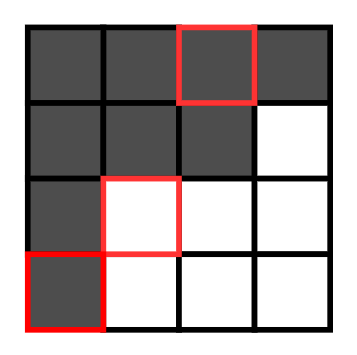
For example, one can color the grid as in the following figure to satisfy the conditions. The cells already colored are surrounded by red borders.
### Sample Explanation 2
No matter how the remaining two cells are colored, the conditions cannot be satisfied.
### Constraints
- $ 1\leq N\leq 10^9 $
- $ 1\leq M\leq \min(N^2,2\times 10^5) $
- $ 1\leq X_i,Y_i\leq N $
- $ (X_i,Y_i)\neq (X_j,Y_j)\ (i\neq j) $
- $ C_i $ is `B` or `W`.
- All input numbers are integers.