AT_abc407_d [ABC407D] Domino Covering XOR
Description
There is a grid with $ H $ rows and $ W $ columns. Let $ (i,j) $ denote the cell at the $ i $ -th row from the top $ (1\leq i\leq H) $ and the $ j $ -th column from the left $ (1\leq j\leq W) $ .
Cell $ (i,j)\ (1\leq i\leq H,1\leq j\leq W) $ has a non-negative integer $ A_{i,j} $ written on it.
Let us place zero or more dominoes on the grid. A domino covers two adjacent cells, namely one of the following pairs:
- cells $ (i,j) $ and $ (i,j+1) $ for $ 1\leq i\leq H,1\leq j\lt W $ ;
- cells $ (i,j) $ and $ (i+1,j) $ for $ 1\leq i\lt H,1\leq j\leq W $ .
No cell may be covered by more than one domino.
For a placement of dominoes, define its **score** as the bitwise XOR of all integers written in cells **not** covered by any domino.
Find the maximum possible score.
What is bitwise XOR? For non-negative integers $ A $ and $ B $ , their bitwise XOR $ A \oplus B $ is defined as follows:
- In binary, the $ 2^k $ bit ( $ k \ge 0 $ ) of $ A \oplus B $ is $ 1 $ if exactly one of $ A $ and $ B $ has $ 1 $ in that bit, and $ 0 $ otherwise.
For example, $ 3 \oplus 5 = 6 $ (in binary, $ 011 \oplus 101 = 110 $ ).
For $ k $ non-negative integers $ p_1, p_2, p_3, \dots, p_k $ , their bitwise XOR is $ (\dots ((p_1 \oplus p_2) \oplus p_3) \oplus \dots \oplus p_k) $ , which can be proved to be independent of the order of the operands.
Input Format
The input is given from Standard Input in the following format:
> $ H $ $ W $ $ A _ {1,1} $ $ A _ {1,2} $ $ \ldots $ $ A _ {1,W} $ $ A _ {2,1} $ $ A _ {2,2} $ $ \ldots $ $ A _ {2,W} $ $ \vdots $ $ A _ {H,1} $ $ A _ {H,2} $ $ \ldots $ $ A _ {H,W} $
Output Format
Output the answer.
Explanation/Hint
### Sample Explanation 1
The grid is as follows:
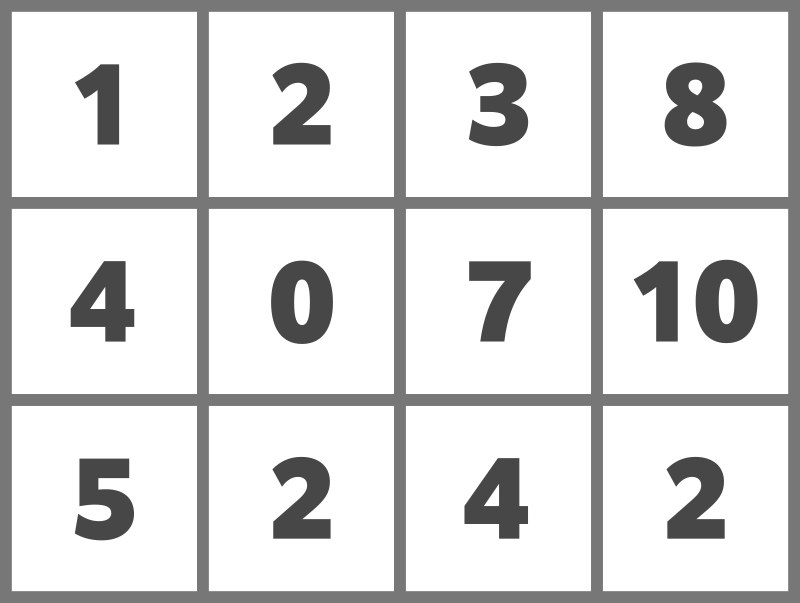
For example, the placement below yields a score of $ 15 $ .
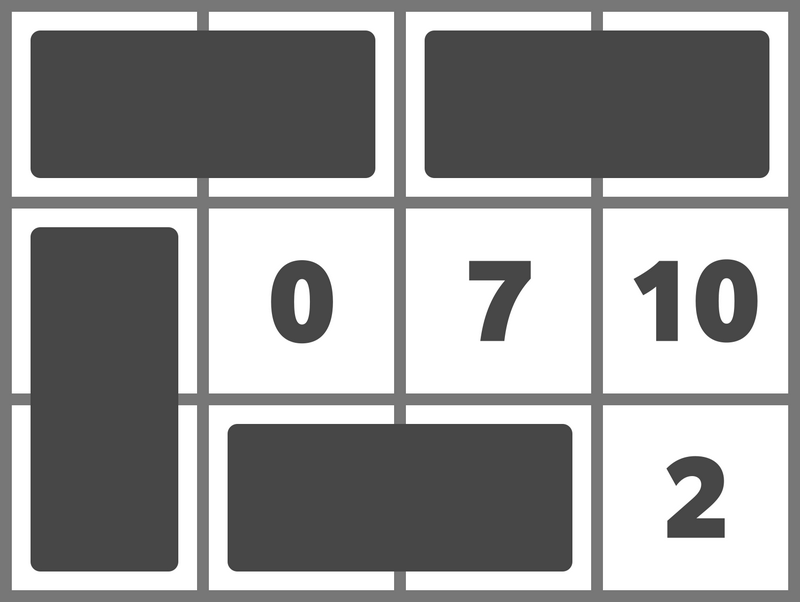
No placement achieves a score of $ 16 $ or higher, so output `15`.
### Sample Explanation 2
You may also choose to place no dominoes.
### Constraints
- $ 1 \le H $
- $ 1 \le W $
- $ HW \le 20 $
- $ 0 \le A_{i,j} < 2^{60} $ ( $ 1 \le i \le H,\ 1 \le j \le W $ )
- All input values are integers.