AT_abc413_g [ABC413G] Big Banned Grid
Description
There is an $ H \times W $ grid. Let $ (i,j) $ denote the cell at the $ i $ -th row $ (1\le i\le H) $ from the top and $ j $ -th column $ (1\le j\le W) $ from the left.
Each cell in the grid either has an obstacle placed on it or has nothing placed on it. There are $ K $ cells with obstacles: cells $ (r_1,c_1),(r_2,c_2),\ldots,(r_K,c_K) $ .
Takahashi is initially at cell $ (1,1) $ and wants to reach cell $ (H,W) $ by repeatedly moving to an adjacent cell (up, down, left, right) that has nothing placed on it.
More precisely, he can repeat the following operation as many times as he likes:
- Choose one of the following four operations and perform the chosen operation:
- If $ 1\lt i $ and cell $ (i-1,j) $ has nothing placed on it, move to cell $ (i-1,j) $ . Otherwise, do not move.
- If $ 1\lt j $ and cell $ (i,j-1) $ has nothing placed on it, move to cell $ (i,j-1) $ . Otherwise, do not move.
- If $ i\lt H $ and cell $ (i+1,j) $ has nothing placed on it, move to cell $ (i+1,j) $ . Otherwise, do not move.
- If $ j\lt W $ and cell $ (i,j+1) $ has nothing placed on it, move to cell $ (i,j+1) $ . Otherwise, do not move.
Determine whether he can move from cell $ (1,1) $ to cell $ (H,W) $ .
Input Format
The input is given from standard input in the following format:
> $ H $ $ W $ $ K $ $ r_1 $ $ c_1 $ $ r_2 $ $ c_2 $ $ \vdots $ $ r_K $ $ c_K $
Output Format
If Takahashi can move from cell $ (1,1) $ to cell $ (H,W) $ by repeating the operation described in the problem, print `Yes`; otherwise, print `No`.
Explanation/Hint
### Sample Explanation 1
The grid looks as follows:
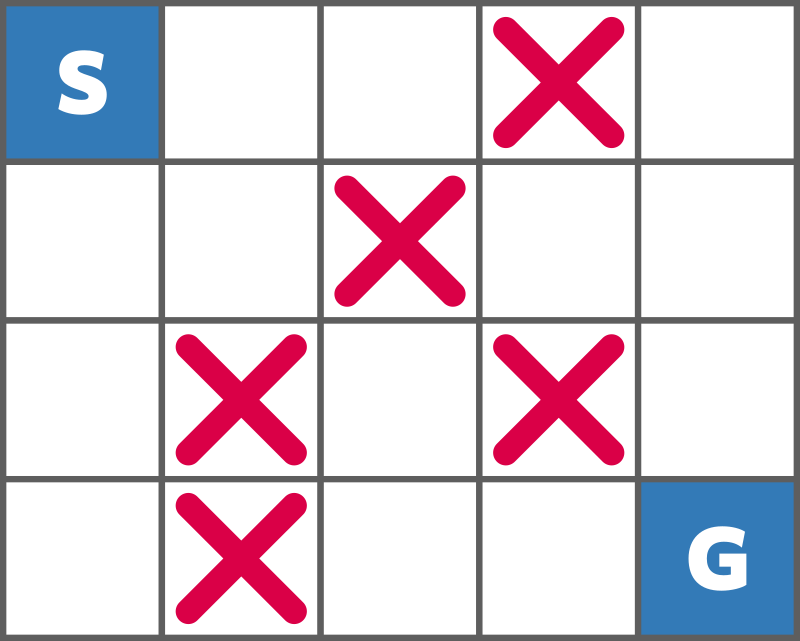
Takahashi cannot move from cell $ (1,1) $ to cell $ (4,5) $ .
### Sample Explanation 2
The grid looks as follows:
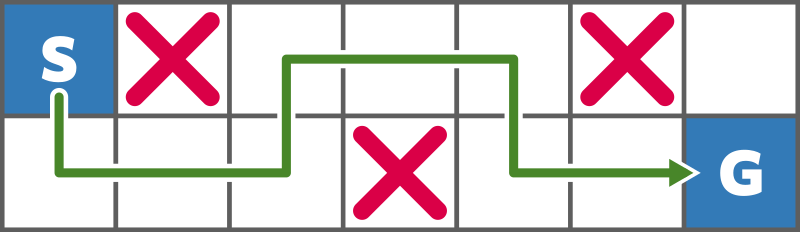
He can move from cell $ (1,1) $ to cell $ (2,7) $ by moving as shown in the figure.
### Sample Explanation 3
Note that there may be cases where he does not need to move or where no obstacles are placed.
### Constraints
- $ 1\le H\le2\times10^5 $
- $ 1\le W\le2\times10^5 $
- $ 0\le K\le2\times10^5 $
- $ 1\le r_i\le H\ (1\le i\le K) $
- $ 1\le c_i\le W\ (1\le i\le K) $
- $ (r_i,c_i)\ne(1,1)\ (1\le i\le K) $
- $ (r_i,c_i)\ne(H,W)\ (1\le i\le K) $
- $ (r_i,c_i)\ne(r_j,c_j)\ (1\le i\lt j\le K) $
- All input values are integers.