AT_abc421_d [ABC421D] RLE Moving
Description
There is an infinitely large grid. One cell of the grid is named cell $ (0,0) $ .
The cell located $ r $ cells down and $ c $ cells right from cell $ (0,0) $ is called cell $ (r,c) $ .
Here, " $ r $ cells down" means " $ |r| $ cells up" when $ r $ is negative, and " $ c $ cells right" means " $ |c| $ cells left" when $ c $ is negative.
Specifically, the cells around cell $ (0,0) $ are as follows:
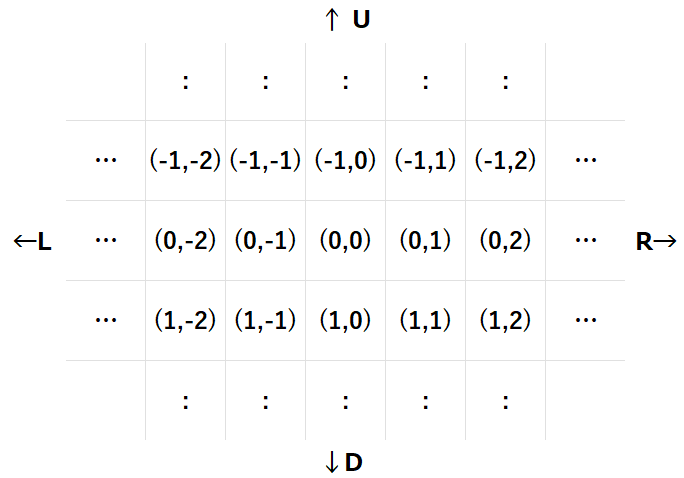
Initially, Takahashi is at cell $ (R_t,C_t) $ and Aoki is at cell $ (R_a,C_a) $ . They will each make $ N $ moves according to strings $ S $ and $ T $ of length $ N $ consisting of `U`, `D`, `L`, `R`.
For each $ i $ , Takahashi's and Aoki's $ i $ -th moves occur simultaneously: Takahashi moves one cell up if the $ i $ -th character of $ S $ is `U`, down if `D`, left if `L`, and right if `R`; Aoki moves similarly according to the $ i $ -th character of $ T $ .
Find the number of times Takahashi and Aoki are at the same cell immediately after a move during the $ N $ moves.
Since $ N $ is very large, $ S $ and $ T $ are given in the form $ ((S'_1, A_1),\ldots,(S'_M,A_M)) $ and $ ((T'_1,B_1),\ldots,(T'_L,B_L)) $ , where $ S $ is the string obtained by concatenating " $ A_1 $ copies of character $ S'_1 $ , $ \dots $ , $ A_M $ copies of character $ S'_M $ " in this order, and $ T $ is given similarly.
Input Format
The input is given from Standard Input in the following format:
> $ R_t $ $ C_t $ $ R_a $ $ C_a $ $ N $ $ M $ $ L $ $ S'_1 $ $ A_1 $ $ \vdots $ $ S'_M $ $ A_M $ $ T'_1 $ $ B_1 $ $ \vdots $ $ T'_L $ $ B_L $
Output Format
Print the answer.
Explanation/Hint
### Sample Explanation 1
In this case, $ S= $ `RRD` and $ T= $ `UUU`, and the movements proceed as follows:
- Initially, Takahashi is at cell $ (0,0) $ and Aoki is at cell $ (4,2) $ .
- After the $ 1 $ st move, Takahashi is at cell $ (0,1) $ and Aoki is at cell $ (3,2) $ .
- After the $ 2 $ nd move, Takahashi is at cell $ (0,2) $ and Aoki is at cell $ (2,2) $ .
- After the $ 3 $ rd move, Takahashi is at cell $ (1,2) $ and Aoki is at cell $ (1,2) $ .
Thus, the number of times Takahashi and Aoki are at the same cell immediately after a move is $ 1 $ .
### Sample Explanation 2
From the $ 2000000000 $ -th move to the $ 3000000000 $ -th move, Takahashi and Aoki are at the same cell immediately after a move for $ 1000000001 $ times.
### Constraints
- $ -10^9 \leq R_t,C_t,R_a,C_a \leq 10^9 $
- $ 1\leq N \leq 10^{14} $
- $ 1\leq M,L \leq 10^5 $
- Each of $ S'_i $ and $ T'_i $ is one of `U`, `D`, `L`, `R`.
- $ 1 \leq A_i,B_i \leq 10^9 $
- $ A_1+\dots+A_M=B_1+\dots+B_L=N $
- All given values are integers.