AT_abc441_d [ABC441D] Paid Walk
Description
There is a directed graph (not necessarily simple) with $ N $ vertices and $ M $ edges, where the vertices are numbered as vertices $ 1, 2, \ldots, N $ .
The $ i $ -th $ (1\leq i\leq M) $ edge goes from vertex $ U_i $ to vertex $ V_i $ with cost $ C_i $ . Additionally, the out-degree of each vertex is at most $ 4 $ .
Find all vertices $ v $ $ (1\leq v\leq N) $ that satisfy the following condition:
> There exists a path from vertex $ 1 $ to vertex $ v $ that satisfies both of the following conditions:
>
> - It traverses exactly $ L $ edges. If the same edge is traversed multiple times, each traversal is counted.
> - The sum of the costs of the traversed edges is at least $ S $ and at most $ T $ . (If the same edge is traversed multiple times, the cost is added to the sum each time.)
What is out-degree? The out-degree of vertex $ u $ refers to the number of edges going out from vertex $ u $ . Even if multiple edges go to the same vertex, they are counted separately.
Input Format
The input is given from Standard Input in the following format:
> $ N $ $ M $ $ L $ $ S $ $ T $
>
> $ U_1 $ $ V_1 $ $ C_1 $
>
> $ U_2 $ $ V_2 $ $ C_2 $
>
> $ \vdots $
>
> $ U_M $ $ V_M $ $ C_M $
Output Format
Print the vertices that satisfy the condition in **ascending order**, separated by spaces.
If there are no vertices that satisfy the condition, print an empty line.
Explanation/Hint
### Sample Explanation 1
The given graph is as shown in the left figure below. The cost of each edge is shown near the starting vertex of that edge.
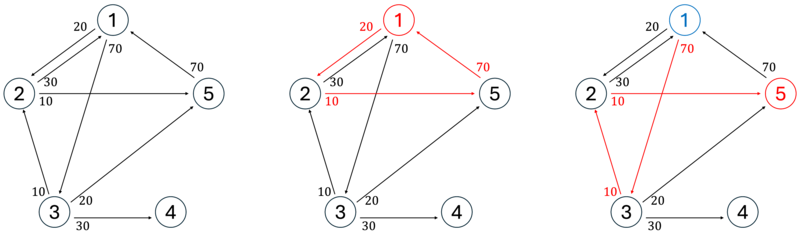
Here, the following holds:
- For the path from vertex $ 1 $ to vertex $ 1 $ , consider vertex $ 1 $ $ \to $ vertex $ 2 $ $ \to $ vertex $ 5 $ $ \to $ vertex $ 1 $ (center of the figure above). This traverses exactly three edges, and the sum of the costs of the traversed edges is $ 20+10+70=100 $ , so it satisfies the condition.
- There is no path from vertex $ 1 $ to vertex $ 2 $ that satisfies the condition. One path that traverses exactly three edges is vertex $ 1 $ $ \to $ vertex $ 2 $ $ \to $ vertex $ 1 $ $ \to $ vertex $ 2 $ , but the sum of the costs of the edges traversed in this path is $ 20+30+20=70 $ , which is less than $ 80 $ , so it does not satisfy the condition.
- There is no path from vertex $ 1 $ to vertex $ 3 $ that satisfies the condition. One path that traverses exactly three edges is vertex $ 1 $ $ \to $ vertex $ 2 $ $ \to $ vertex $ 1 $ $ \to $ vertex $ 3 $ , but the sum of the costs of the edges traversed in this path is $ 20+30+70=120 $ , which is greater than $ 100 $ , so it does not satisfy the condition.
- There is no path from vertex $ 1 $ to vertex $ 4 $ that satisfies the condition.
- For the path from vertex $ 1 $ to vertex $ 5 $ , consider vertex $ 1 $ $ \to $ vertex $ 3 $ $ \to $ vertex $ 2 $ $ \to $ vertex $ 5 $ (right of the figure above). This traverses exactly three edges, and the sum of the costs of the traversed edges is $ 70+10+10=90 $ , so it satisfies the condition.
Therefore, print $ 1 $ , $ 5 $ in this order. Note that you need to print those vertices that satisfy the condition in ascending order.
### Sample Explanation 2
If there are no vertices that satisfy the condition, print an empty line.
### Sample Explanation 3
The graph may contain self-loops and multiple edges.
In this test case, the out-degrees from vertices $ 1 $ and $ 2 $ are $ 4 $ and $ 1 $ , respectively.
### Constraints
- $ 1\leq N\leq 2\times 10^5 $
- $ 1\leq M\leq 2\times 10^5 $
- $ 1\leq L \leq 10 $
- $ 1\leq S\leq T \leq 10^9 $
- $ 1\leq U_i,V_i\leq N $
- $ 1\leq C_i\leq 10^8 $
- The out-degree of each vertex is at most $ 4 $ .
- All input values are integers.