AT_abc441_g [ABC441G] Takoyaki and Flip
Description
$ N $ plates are arranged in a straight line from left to right. Let us call the $ i $ -th plate from the left $ (1\le i\le N) $ plate $ i $ . Initially, all plates are placed face-up, and no plates have takoyaki (octopus dumplings) on them.
Process a total of $ Q $ queries of the following three types:
- Type $ 1 $ : You are given integers $ L,R,X $ . For $ i=L,L+1,\ldots,R $ , if plate $ i $ is placed face-up, place $ X $ takoyaki on plate $ i $ .
- Type $ 2 $ : You are given integers $ L,R $ . For $ i=L,L+1,\ldots,R $ , if there is at least one takoyaki on plate $ i $ , eat all the takoyaki on plate $ i $ . Flip plate $ i $ (if the plate is placed face-up, place it face-down; otherwise, place it face-up).
- Type $ 3 $ : You are given integers $ L,R $ . Print the maximum number of takoyaki on one plate among plates $ L, $ $ L+1,\ldots, $ $ R $ .
Input Format
The input is given from Standard Input in the following format:
> $ N $ $ Q $
>
> $ \mathrm{query} _ 1 $
>
> $ \mathrm{query} _ 2 $
>
> $ \vdots $
>
> $ \mathrm{query} _ Q $
Here, $ \mathrm{query} _ i $ represents the $ i $ -th $ (1\le i\le Q) $ query and is given in one of the following formats:
> $ t $ $ L $ $ R $ $ X $
> $ t $ $ L $ $ R $
These indicate that the $ i $ -th query is of type $ t $ and the given integers are $ L,R,X $ or $ L,R $ . Type $ 1 $ queries are given in the former format, and other queries are given in the latter format.
Output Format
Let $ q $ be the number of type $ 3 $ queries. Print $ q $ lines. The $ i $ -th line $ (1\le i\le q) $ should contain the answer to the $ i $ -th type $ 3 $ query from the beginning.
Explanation/Hint
### Sample Explanation 1
At the time of each query, the state of each plate and the number of takoyaki on it are as shown in the figure below.
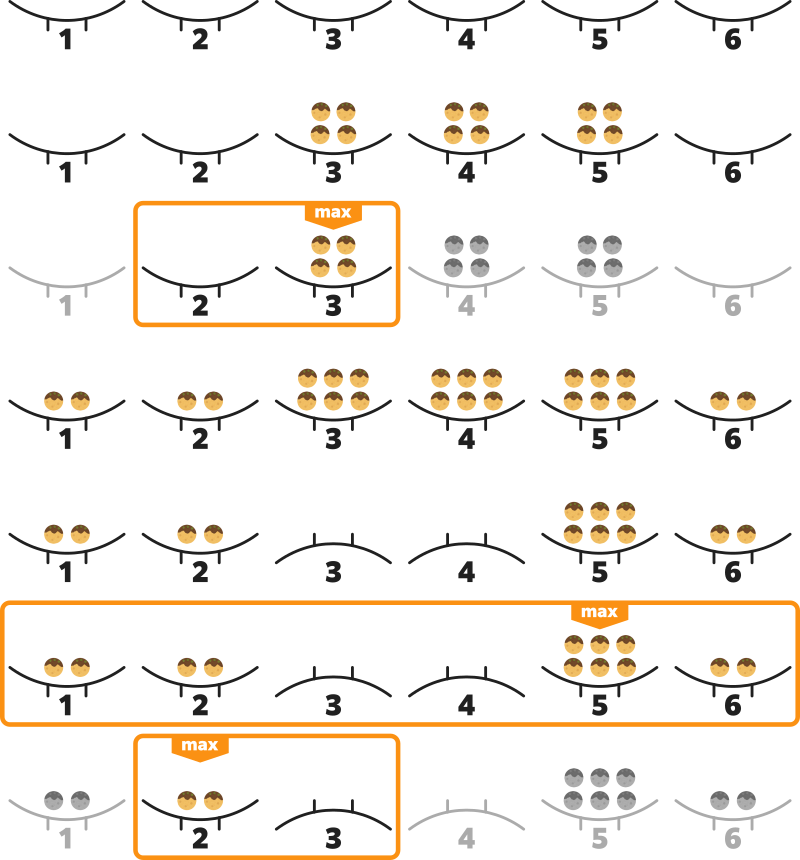
At the time of the second query, among plates $ 2 $ and $ 3 $ , the one with more takoyaki is plate $ 3 $ . Thus, print `4`, the number of takoyaki on plate $ 3 $ , on the first line.
At the time of the fifth query, among plates $ 1, $ $ 2,\ldots, $ $ 6 $ , the one with the most takoyaki is plate $ 5 $ . Thus, print `6`, the number of takoyaki on plate $ 5 $ , on the second line.
At the time of the sixth query, among plates $ 2 $ and $ 3 $ , the one with more takoyaki is plate $ 2 $ . Thus, print `2`, the number of takoyaki on plate $ 2 $ , on the third line.
### Sample Explanation 2
Note that no takoyaki is placed on plates that are placed face-down.
Also, note that the answer may be $ 2 ^ {32} $ or more.
### Constraints
- $ 1\le N\le2\times10 ^ 5 $
- $ 1\le Q\le2\times10 ^ 5 $
- In all queries, $ 1\le L\le R\le N $ .
- In type $ 1 $ queries, $ 1\le X\le10 ^ 9 $ .
- There is at least one type $ 3 $ query.
- All input values are integers.