AT_abc445_g [ABC445G] Knight Placement
Description
There is a grid with $ N $ rows and $ N $ columns. The cell at the $ i $ -th row from the top $ (1 \le i \le N) $ and the $ j $ -th column from the left $ (1 \le j \le N) $ is called cell $ (i,j) $ .
Each cell is an empty cell or a wall cell, represented by a sequence of $ N $ strings of length $ N $ each, $ (S_1,S_2,\ldots,S_N) $ . Cell $ (i,j)\ (1 \le i \le N,1 \le j \le N) $ is an empty cell if the $ j $ -th character of $ S_i $ is `.`, and a wall cell if it is `#`.
You want to place as many pieces as possible on this grid. The placement of pieces is subject to the following constraints.
- A piece cannot be placed on a wall cell.
- At most one piece can be placed on a single cell.
- If a piece is placed on cell $ (i,j) $ , no piece can be placed on the cell reached by moving $ A $ cells vertically and $ B $ cells horizontally from cell $ (i,j) $ , or the cell reached by moving $ B $ cells vertically and $ A $ cells horizontally. More formally, if a piece is placed on cell $ (i,j) $ , then no piece can be placed on any of cell $ (i+A,j+B), $ cell $ (i+B,j+A), $ cell $ (i+B,j-A), $ cell $ (i+A,j-B), $ cell $ (i-A,j-B), $ cell $ (i-B,j-A), $ cell $ (i-B,j+A), $ cell $ (i-A,j+B) $ (if those cells exist).
Let $ K $ be the maximum number of pieces that can be placed under these constraints, and find one placement of $ K $ pieces satisfying the constraints.
Input Format
The input is given from Standard Input in the following format:
> $ N $ $ A $ $ B $ $ S_1 $ $ S_2 $ $ \vdots $ $ S_N $
Output Format
Find one placement of $ K $ pieces satisfying the constraints, and output it as strings over $ N $ lines. The $ i $ -th line $ (1 \le i \le N) $ should contain a string of $ N $ characters consisting of `.`, `o`, and `#`. The $ j $ -th character $ (1 \le j \le N) $ of the string on the $ i $ -th line should be `.` if cell $ (i,j) $ is an empty cell with no piece, `o` if cell $ (i,j) $ is an empty cell with a piece, and `#` if cell $ (i,j) $ is a wall cell.
If there are multiple valid placements, any of them will be accepted.
Explanation/Hint
### Sample Explanation 1
For example, $ 10 $ pieces can be placed as follows while satisfying the constraints.
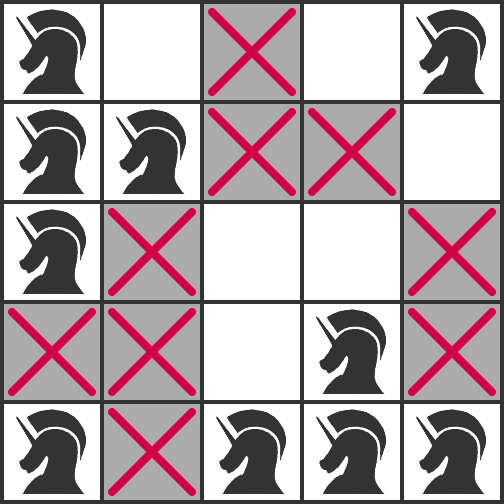
It is impossible to place $ 11 $ pieces while satisfying the constraints, so outputting the board corresponding to the placement above,
```
o.#.o
oo##.
o#..#
##.o#
o#ooo
```
will be judged as correct.
Note that any valid placement will be accepted if there are multiple of them. For example, the following also allows $ 10 $ pieces to be placed while satisfying the constraints.
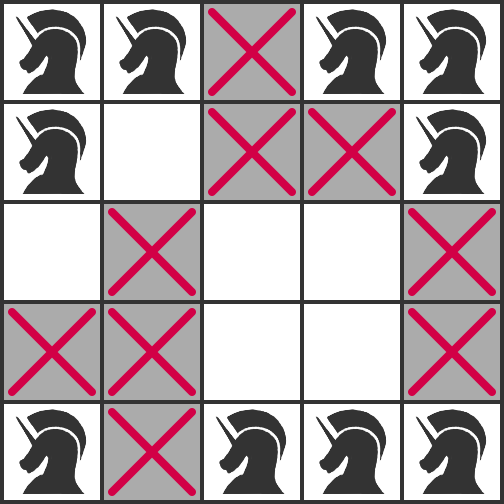
Thus, outputting
```
oo#oo
o.##o
.#..#
##..#
o#ooo
```
will also be judged as correct.
### Sample Explanation 2
The constraints can be satisfied by placing one piece on each empty cell.
### Constraints
- $ 1 \le N \le 300 $
- $ 0 \le A \le B \le N $
- $ 1 \le B $
- $ N,A,B $ are integers.
- $ S_i $ is a string of length $ N $ consisting of `.` and `#` $ (1 \le i \le N) $ .