AT_abc447_f [ABC447F] Centipede Graph
Description
You are given a tree $ T $ with $ N $ vertices numbered $ 1 $ to $ N $ . The $ i $ -th edge connects vertices $ A_i $ and $ B_i $ .
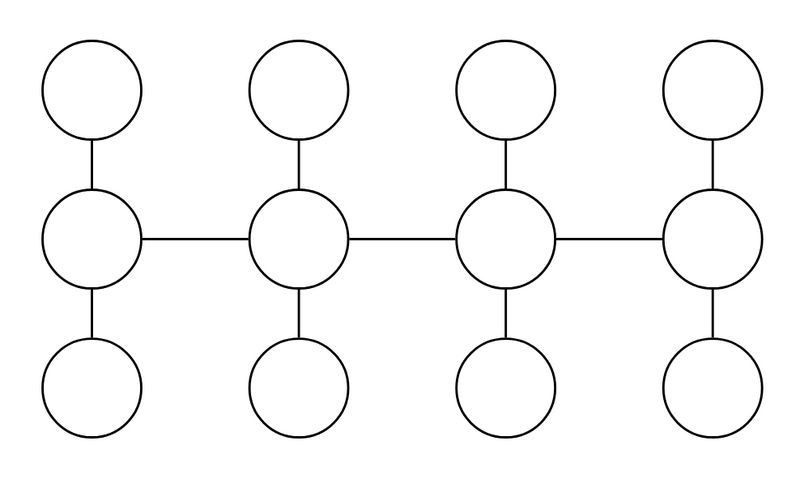
For a positive integer $ k $ , define a "centipede graph of length $ k $ " as a graph with $ 3k $ vertices obtained by the following procedure:
- Prepare a path graph with $ k $ **vertices**.
- For each vertex $ v $ of the path graph, add two new vertices adjacent only to $ v $ .
For example, a centipede graph of length $ 4 $ is as shown in the figure below.
Find the maximum $ x $ such that a "centipede graph of length $ x $ " is contained as a subgraph of tree $ T $ .
$ Q $ test cases are given; solve each of them.
Input Format
The input is given from Standard Input in the following format:
> $ Q $ $ \text{case}_1 $ $ \text{case}_2 $ $ \vdots $ $ \text{case}_Q $
Each test case is given in the following format:
> $ N $ $ A_1 $ $ B_1 $ $ A_2 $ $ B_2 $ $ \vdots $ $ A_{N-1} $ $ B_{N-1} $
Output Format
Output $ Q $ lines.
The $ i $ -th line should contain the answer for the $ i $ -th test case.
Explanation/Hint
### Sample Explanation 1
For the first test case, the graph consisting of the six vertices $ 2,3,4,5,6,8 $ forms a "centipede graph of length $ 2 $ ".
No centipede graph of length $ 3 $ or more is contained as a subgraph, so the answer is $ 2 $ . Thus, output $ 2 $ .
### Constraints
- $ 1 \le Q $
- $ 3 \le N \le 2 \times 10^5 $
- $ 1 \le A_i, B_i \le N $
- The given graph is a tree.
- The sum of $ N $ over all test cases is at most $ 2 \times 10^5 $ .
- All input values are integers.