AT_abc452_c [ABC452C] Fishbones
Description
Artist Takasago has created an object in the shape of a fish skeleton.
The object consists of $ N $ ribs and one spine. The ribs are numbered $ 1 $ through $ N $ .
He wants to write one string on each of the $ N+1 $ bones, satisfying all of the following conditions.
- The length of the string written on the spine is $ N $ .
- For each rib $ i = 1, \dots, N $ , the following hold.
- The length of the string written on rib $ i $ is $ A_i $ .
- The $ B_i $ -th character of the string written on rib $ i $ equals the $ i $ -th character of the string written on the spine.
- Each of the strings written on the $ N+1 $ bones is one of $ S_1, \cdots, S_M $ (duplicates allowed).
$ S_1, \cdots, S_M $ are strings consisting of lowercase English letters, and they are all distinct.
For each $ j = 1, \cdots, M $ , answer the following question.
- Among the ways to write strings satisfying the conditions, is there one where the string written on the spine is $ S_j $ ?
Input Format
The input is given from Standard Input in the following format:
> $ N $ $ A_1 $ $ B_1 $ $ \vdots $ $ A_N $ $ B_N $ $ M $ $ S_1 $ $ \vdots $ $ S_M $
Output Format
Output $ M $ lines.
The $ j $ -th line ( $ 1 \leq j \leq M $ ) should contain `Yes` if there exists a way to write strings satisfying the conditions with $ S_j $ written on the spine, and `No` otherwise.
Explanation/Hint
### Sample Explanation 1
By writing `chris`, `retro`, `tuna`, `retro`, `cod` on ribs $ 1,2,3,4,5 $ respectively, the conditions are satisfied with `retro` written on the spine.
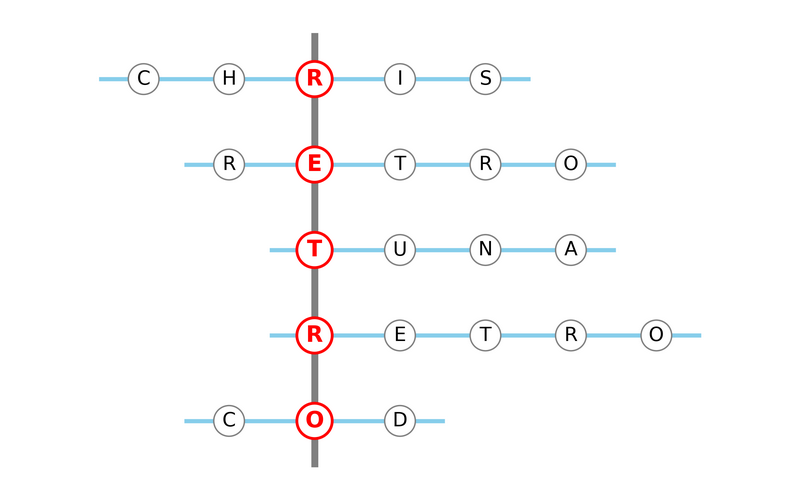
- The length of `retro` is $ 5 $ .
- For each rib, the following hold.
- The string written on rib $ 1 $ is `chris`, which has length $ 5 $ . Its third character is `r`, which equals the first character of `retro`.
- The string written on rib $ 2 $ is `retro`, which has length $ 5 $ . Its second character is `e`, which equals the second character of `retro`.
- The string written on rib $ 3 $ is `tuna`, which has length $ 4 $ . Its first character is `t`, which equals the third character of `retro`.
- The string written on rib $ 4 $ is `retro`, which has length $ 5 $ . Its first character is `r`, which equals the fourth character of `retro`.
- The string written on rib $ 5 $ is `cod`, which has length $ 3 $ . Its second character is `o`, which equals the fifth character of `retro`.
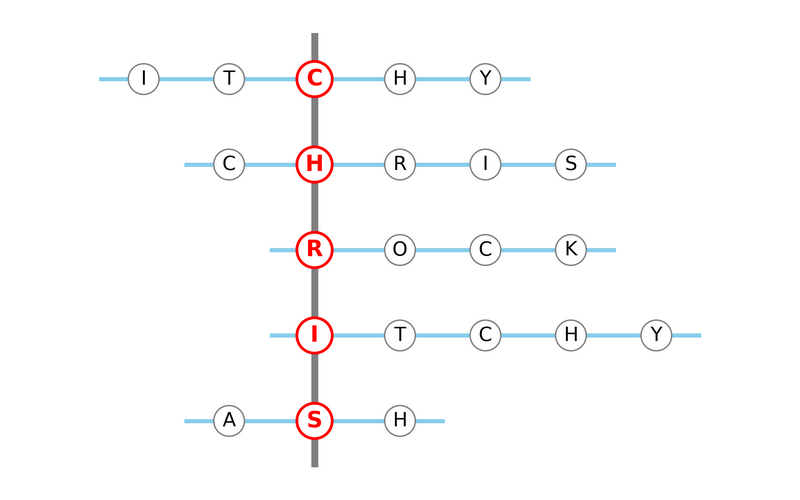
By writing `itchy`, `chris`, `rock`, `itchy`, `ash` on ribs $ 1,2,3,4,5 $ respectively, the conditions are satisfied with `chris` written on the spine.
### Constraints
- $ N $ is an integer.
- $ 1 \leq N \leq 10 $
- $ A_i $ and $ B_i $ are integers. ( $ 1 \leq i \leq N $ )
- $ 1 \leq B_i \leq A_i \leq 10 $ ( $ 1 \leq i \leq N $ )
- $ M $ is an integer.
- $ 1 \leq M \leq 200\,000 $
- $ S_j $ is a string consisting of lowercase English letters. ( $ 1 \leq j \leq M $ )
- $ 1 \leq |S_j| \leq 10 $ ( $ 1 \leq j \leq M $ )
- $ S_1, \cdots, S_M $ are pairwise distinct.