AT_abc466_d [ABC466D] Placing Rooks
Description
There is a grid with $ N $ rows and $ N $ columns.
Initially, nothing is placed on the grid.
Starting from this state, Takahashi performs $ M $ operations on the grid in order. The $ i $ -th operation $ (1\leq i\leq M) $ is as follows.
- Remove all pieces placed on the cells in the $ R_i $ -th row from the top.
- Next, remove all pieces placed on the cells in the $ C_i $ -th column from the left.
- Finally, place a piece on the cell at the $ R_i $ -th row from the top and the $ C_i $ -th column from the left.
Output the number of pieces placed on the grid after the $ M $ operations.
Input Format
The input is given from Standard Input in the following format:
> $ N $ $ M $ $ R_1 $ $ C_1 $ $ R_2 $ $ C_2 $ $ \vdots $ $ R_M $ $ C_M $
Output Format
Output the number of pieces placed on the grid after the $ M $ operations.
Explanation/Hint
### Sample Explanation 1
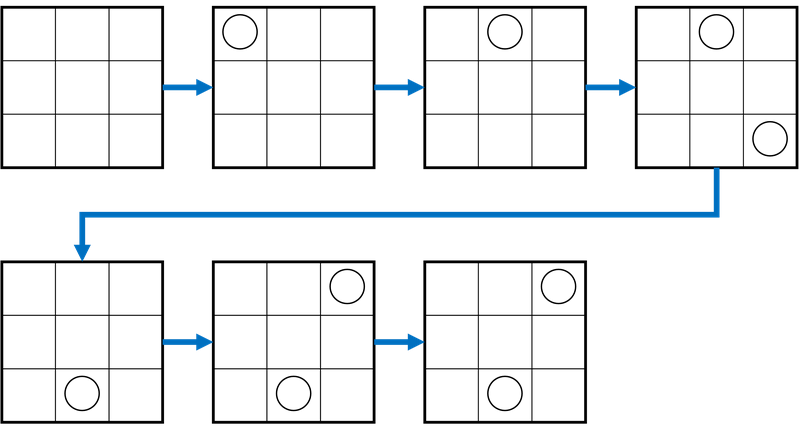
Initially, nothing is placed on the grid with three rows and three columns, and pieces are removed and placed by each operation as follows.
Below, the cell at the $ i $ -th row from the top and the $ j $ -th column from the left is denoted as cell $ (i,j) $ .
- In the first operation, a piece is placed on cell $ (1,1) $ .
- In the second operation, the piece is removed from cell $ (1,1) $ , and a piece is placed on cell $ (1,2) $ .
- In the third operation, a piece is placed on cell $ (3,3) $ .
- In the fourth operation, the pieces are removed from cell $ (1,2) $ and cell $ (3,3) $ , and a piece is placed on cell $ (3,2) $ .
- In the fifth operation, a piece is placed on cell $ (1,3) $ .
- In the sixth operation, the piece is removed from cell $ (1,3) $ , and a piece is placed on cell $ (1,3) $ again.
In the final state, there is one piece each on cell $ (1,3) $ and cell $ (3,2) $ , so output $ 2 $ .
### Constraints
- $ 1 \leq N \leq 3\times 10^5 $
- $ 1 \leq M \leq 3\times 10^5 $
- $ 1 \leq R_i \leq N $
- $ 1 \leq C_i \leq N $
- All input values are integers.