AT_agc077_b [AGC077B] Long Increasing Walk
Description
You are given positive integers $ N $ and $ K $ .
There is a complete bipartite graph $ G $ with $ N $ vertices $ l_1, l_2, \ldots, l_N $ on the left and $ N $ vertices $ r_1, r_2, \ldots, r_N $ on the right. It has $ N^2 $ edges; for each $ (i, j)\ (1\leq i\leq N, 1\leq j\leq N) $ , there is one undirected edge between vertices $ l_i $ and $ r_j $ .
Determine whether there exists a way to write an integer between $ 1 $ and $ N^2 $ , inclusive, on each edge of $ G $ (where the $ N^2 $ integers written are all distinct) such that the answer to the following problem is $ K $ , and if such a way exists, find one.
> Among all walks on graph $ G $ , we call a walk **good** if the sequence of numbers written on the edges traversed, in the order they are traversed, is strictly increasing.
>
> Find the maximum number of edges contained in a good walk.
$ T $ test cases are given; solve each of them.
What is a walk? A walk on graph $ G $ is a sequence of $ k $ vertices and $ k-1 $ edges alternately arranged, $ (v_1 ,e_1 ,v_2 ,\ldots,v_{k−1} ,e_{k−1} ,v_k) $ (where $ k $ is a positive integer), such that edge $ e_i $ connects vertices $ v_i $ and $ v_{i+1} $ .
Input Format
The input is given from Standard Input in the following format:
> $ T $ $ \mathrm{case}_1 $ $ \mathrm{case}_2 $ $ \vdots $ $ \mathrm{case}_T $
Each test case is given in the following format:
> $ N $ $ K $
Output Format
Output the answers for $ \mathrm{case}_1,\mathrm{case}_2,\ldots,\mathrm{case}_T $ in this order in the following format.
If no valid way of writing exists, output `No`.
If a valid way exists, letting $ A_{i,j} $ be the integer written on the edge connecting vertices $ l_i $ and $ r_j $ ,
> Yes $ A_{1,1} $ $ A_{1,2} $ $ \ldots $ $ A_{1,N} $ $ A_{2,1} $ $ A_{2,2} $ $ \ldots $ $ A_{2,N} $ $ \vdots $ $ A_{N,1} $ $ A_{N,2} $ $ \ldots $ $ A_{N,N} $
output as above. $ (A_{1,1},\ldots,A_{1,N},A_{2,1},\ldots,A_{2,N},\ldots,A_{N,1},\ldots,A_{N,N}) $ must be a permutation of $ (1,2,\ldots,N^2) $ .
If multiple solutions exist, any of them will be accepted.
Explanation/Hint
### Sample Explanation 1
For the first test case, no valid way of writing exists.
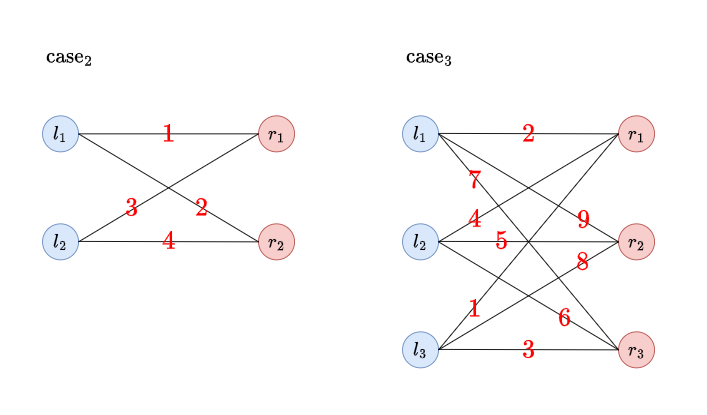
For the second test case, a good walk containing three edges is $ r_1 \xrightarrow{1} l_1 \xrightarrow{2}r_2\xrightarrow{4}l_2 $ . No good walk contains four or more edges, so this output satisfies the condition.
For the third test case, a good walk containing five edges is $ l_1 \xrightarrow{2} r_1 \xrightarrow{4}l_2\xrightarrow{6}r_3 \xrightarrow{7} l_1 \xrightarrow{9} r_2 $ . No good walk contains six or more edges, so this output satisfies the condition.
### Constraints
- $ 1\leq T\leq 3000 $
- $ 1\leq N\leq 700 $
- $ 1\leq K\leq N^2 $
- The sum of $ N^2 $ in each input is at most $ 5\times 10^5 $ .
- All input values are integers.