AT_arc224_b [ARC224B] Adjacent Tiles
Description
Let us place $ N $ square tiles of the same size on a plane so that they do not overlap.
Then, what is the maximum possible number of pairs of different tiles that **share one full side**?
Here, a pair of different tiles $ (a,b) $ is said to share one full side if and only if some side of $ a $ and some side of $ b $ coincide completely.
$ T $ test cases are given; solve each of them.
Input Format
The input is given from Standard Input in the following format, where $ \mathrm{case}_i $ denotes the $ i $ -th test case:
> $ T $ $ \mathrm{case}_1 $ $ \mathrm{case}_2 $ $ \vdots $ $ \mathrm{case}_T $
Each test case is given in the following format:
> $ N $
Output Format
Output $ T $ lines. The $ i $ -th line should contain the answer for the $ i $ -th test case.
Explanation/Hint
### Sample Explanation 1
This input contains six test cases.
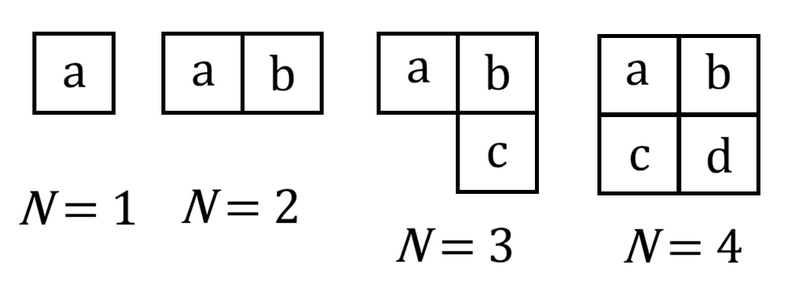
The figure below shows an example of an optimal arrangement of tiles for $ N=1,2,3,4 $ .
- For the first test case, $ N=1 $ .
- There is no pair of different tiles sharing one full side.
- For the second test case, $ N=2 $ .
- The pair of tiles $ ({\rm a,b}) $ shares one full side.
- For the third test case, $ N=3 $ .
- The pairs of tiles $ ({\rm a,b}),({\rm b,c}) $ share one full side.
- For the fourth test case, $ N=4 $ .
- The pairs of tiles $ ({\rm a,b}),({\rm a,c}),({\rm b,d}),({\rm c,d}) $ share one full side.
### Constraints
- $ 1 \le T \le 2 \times 10^5 $
- $ 1 \le N \le 10^{18} $
- All input values are integers.