AT_arc226_e [ARC226E] Cellular Messenger
Description
> Snuke wants to design a cellular automaton that conveys a binary sequence, written into a certain cell over $ N $ turns, to a distant cell.
#### 1. Grid
There is an infinitely large grid. Each cell has a state of $ 0 $ or $ 1 $ .
Let some row of the grid be row $ 0 $ and some column be column $ 0 $ , with row numbers increasing by $ 1 $ downward and column numbers increasing by $ 1 $ to the right. Let $ (r,c) $ denote the coordinates of the cell at row $ r $ and column $ c $ . The coordinates of the cells are as shown in the figure below.
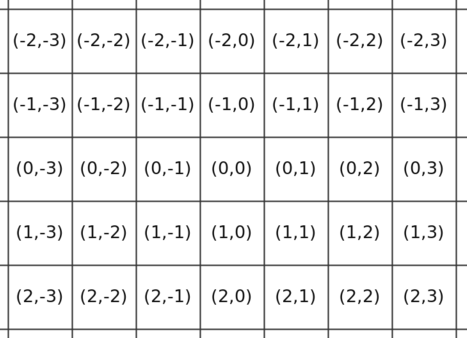
The cells adjacent to a given cell refer to the eight cells sharing an edge or a vertex with it.
You may choose a rectangular region satisfying the following conditions, and freely set the initial states of the cells within the region.
- Both the height $ H $ and the width $ W $ are between $ 1 $ and $ 150 $ , inclusive.
- The coordinates of the top-left cell are $ (0,0) $ .
The initial states of all cells outside the region are $ 0 $ .
#### 2. Update Operation
Decide on a value $ F_{i,j} $ , either $ 0 $ or $ 1 $ , for each $ i=0,1 $ and $ j=0,1,\ldots,8 $ ; let these values be the **update rule**. However, $ F_{0,0}=0 $ must hold.
In the **update operation**, the states of all cells are updated simultaneously. For a given cell, let $ i $ be its state before the update and $ j $ be the sum of the states of the eight adjacent cells; then its state after the update is $ F_{i,j} $ .
#### 3. Designing the Automaton
You need to decide on and output the following values.
- The update rule $ F_{i,j} $ $ (i=0,1) $ $ (0 \le j \le 8) $
- $ F_{0,0}=0 $ must hold.
- The height $ H $ and width $ W $ of the rectangular region for which the initial state is set
- Both $ H $ and $ W $ must be between $ 1 $ and $ 150 $ , inclusive.
- The initial states $ A_{r,c} $ $ (0 \le r \lt H) $ $ (0 \le c \lt W) $ within the rectangular region
- The coordinates $ (R_s,C_s) $ of the **sending cell** and $ (R_t,C_t) $ of the **receiving cell**
- $ 0 \le R_s,R_t \lt H $ and $ 0 \le C_s,C_t \lt W $ must hold.
- $ 50 \le |C_s-C_t| \le 100 $ must hold.
- The delay $ D $ from sending to receiving
- It must be possible to read, at the receiving cell on turn $ k+D-1 $ , the value that was written to the sending cell on turn $ k $ .
- $ 50 \le D \le 100 $ must hold.
#### 4. Judging Method
Judging is performed as follows.
1. Decide on a positive integer $ N $ and a sequence $ S=(S_1,S_2, \ldots ,S_N) $ of length $ N $ consisting of $ 0 $ s and $ 1 $ s. These are fixed for each test case.
2. Receive the design of the automaton that you output.
3. Prepare an empty sequence $ T $ , and simulate $ N+D-1 $ turns starting from the initial state. Specifically, for each $ k=1,2,\ldots,N+D-1 $ , perform the following steps in order on turn $ k $ .
1. If $ k \le N $ , change the state of the sending cell $ (R_s,C_s) $ to $ S_k $ .
2. Perform one update operation on the grid.
3. If $ D \le k < D+N $ , append the state of the receiving cell $ (R_t,C_t) $ to the end of $ T $ .
4. After the simulation ends, if $ S=T $ , your output is judged correct; otherwise, it is judged incorrect.
It is guaranteed that there exists a design of the automaton that is judged correct regardless of $ N $ and $ S $ , but due to implementation details of the judge for this problem, $ N $ and $ S $ are fixed for each test case file, and only cases with $ N \le 300 $ are used.
Input Format
This problem provides no input.
Output Format
Output in the following format:
> $ F_{0,0}F_{0,1}\ldots F_{0,8} $ $ F_{1,0}F_{1,1}\ldots F_{1,8} $ $ H $ $ W $ $ A_{0,0}A_{0,1}\ldots A_{0,W-1} $ $ A_{1,0}A_{1,1}\ldots A_{1,W-1} $ $ \vdots $ $ A_{H-1,0}A_{H-1,1}\ldots A_{H-1,W-1} $ $ R_s $ $ C_s $ $ R_t $ $ C_t $ $ D $
Your output must satisfy the following conditions.
- $ F_{i,j} \in \{0,1\} $
- $ F_{0,0} = 0 $
- $ 1 \le H,W \le 150 $
- $ A_{r,c} \in \{0,1\} $
- $ 0 \le R_s,R_t \lt H $
- $ 0 \le C_s,C_t \lt W $
- $ 50 \le |C_s-C_t| \le 100 $
- $ 50 \le D \le 100 $
If your output satisfies the above conditions, and is judged correct by the judging method described above for all prepared test cases, this problem is considered solved.
Explanation/Hint
### Visualizer
You can check the behavior of your automaton using the [visualizer](https://img.atcoder.jp/arc226/d6db7b23c48a5b0d7f696e474dcc3233.html).
### Sample Explanation 1
This sample output is provided to illustrate the output format. For $ N=1 $ , it is correct for all $ S $ , but for $ 2 \le N $ , there exist some $ S $ for which it is incorrect.
### Constraints
- The $ N $ used by the judge is between $ 1 $ and $ 300 $ , inclusive.