AT_ttpc2024_1_a Don't Detect Cycle
Description
You are given a graph $ G $ consisting of $ N $ vertices numbered $ 1, 2, \ldots, N $ . Initially, $ G $ has no edges.
You will add $ M $ undirected edges to $ G $ . The final shape of the graph is predetermined, and the $ i $ -th edge to be added $ (1
> You must be able to add all $ M $ edges to $ G $ by following this procedure:
>
> - For $ i = 1, 2, \dots, M $ , repeat the following:
> 1. If there is already a cycle in $ G $ containing either vertex $ u_{P_i} $ or vertex $ v_{P_i} $ , the condition is not satisfied, and the procedure ends.
> 2. Add edge $ P_i $ (the undirected edge connecting $ u_{P_i} $ and $ v_{P_i} $ ) to $ G $ .
You are given $ T $ test cases; solve each of them.
What is a cycle? A cycle in $ G $ is defined as a sequence of vertices $ (v_0, \dots, v_{L - 1}) $ and a sequence of edges $ (e_0, \dots, e_{L - 1}) $ that satisfy the following conditions: - $ L \ge 1 $
- $ i \neq j \implies v_i \neq v_j, e_i \neq e_j $
- For $ 0 \le i \le L - 2 $ , edge $ e_i $ connects vertices $ v_i $ and $ v_{i+1} $
- Edge $ e_{L-1} $ connects vertices $ v_{L-1} $ and $ v_0 $
What does it mean for a graph to be simple? A graph $ G $ is simple if it contains no self-loops or multiple edges.
Input Format
The input is given from Standard Input in the following format:
> $ T $ $ \text{case}_1 $ $ \text{case}_2 $ $ \vdots $ $ \text{case}_T $
Here, $ \text{case}_i\ (1
Output Format
For each test case, if a permutation $ (P_1, P_2, \ldots, P_M) $ satisfying the conditions exists, output such a $ P $ separated by spaces. If no such permutation exists, output `-1`.
Explanation/Hint
### Subtasks
$ 30 $ points will be awarded for passing the test set satisfying:
- $ T \le 50 $
- For each test case:
- $ N \le 100 $
- $ M \le 100 $
- The sum of $ N $ over all test cases is at most $ 100 $ .
- The sum of $ M $ over all test cases is at most $ 100 $ .
### Sample Explanation 1
The given graph has the following shape:
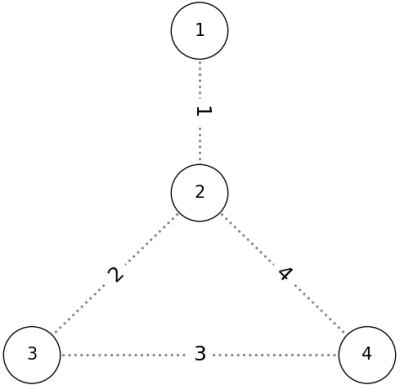
If we add the edges in the order $ P = (1, 2, 3, 4) $ , the conditions are satisfied as shown below:
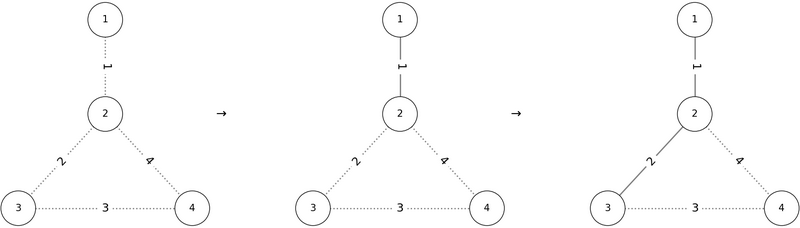 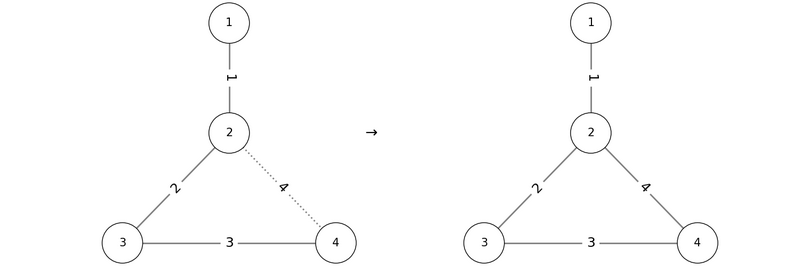
Thus, `1 2 3 4` is one valid output.
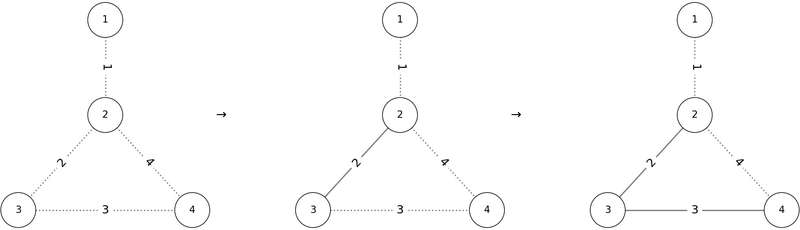
However, if we add edges in the order $ P = (2, 3, 4, 1) $ , a cycle containing vertex $ 2 $ is created before edge $ 1 $ can be added, so the conditions are not satisfied.
 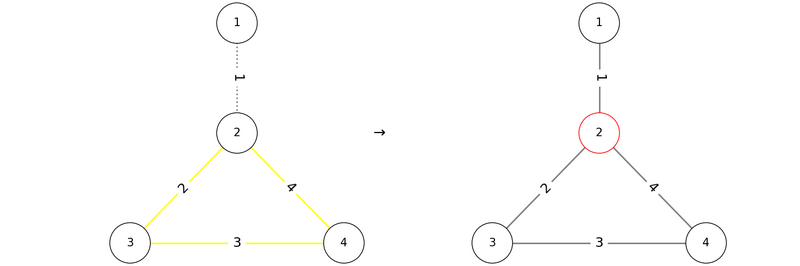
Other valid outputs include $ P = (1, 4, 3, 2) $ or $ P = (2, 4, 1, 3) $ .
### Sample Explanation 2
If no valid $ P $ exists, output `-1`. Note that the graph is not necessarily connected.
### Constraints
- All input values are integers.
- $ 1 \le T \le 2000 $
- For each test case:
- $ 2 \le N \le 4000 $
- $ 1 \le M \le 4000 $
- $ 1 \le u_i, v_i \le N\ (1