AT_ttpc2024_1_c Segment Tree
Description
You are given an undirected graph $ G $ with $ 2^N + 1 $ vertices and $ 2^{N+1} - 1 $ edges. The vertices are numbered $ 0, 1, \dots, 2^N $ , and the edges are numbered $ 1, 2, \dots, 2^{N+1}-1 $ .
Each edge in $ G $ belongs to one of $ N+1 $ types, ranging from type $ 0 $ to type $ N $ .
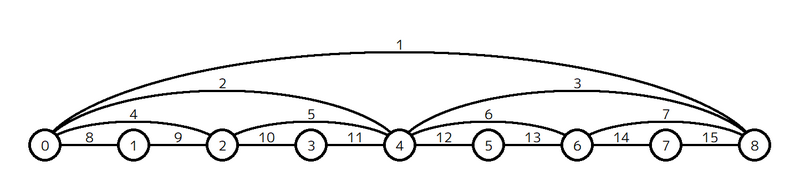
For type $ i $ $ (0 \le i \le N) $ , there are exactly $ 2^i $ edges, which are numbered $ 2^i+0, 2^i+1, \dots, 2^i+(2^i-1) $ . The edge numbered $ 2^i + j $ $ (0 \leq j \leq 2^i - 1) $ is an undirected edge of length $ C_{2^i + j} $ that connects vertex $ j \times 2^{N-i} $ and vertex $ (j+1) \times 2^{N-i} $ .
For example, when $ N = 3 $ , $ G $ looks like the following graph:
You are given $ Q $ queries to process. There are two types of queries:
- `1 j x`: Change the length of edge $ j $ to $ x $ .
- `2 s t`: Find the shortest path length from vertex $ s $ to vertex $ t $ .
Input Format
The input is given in the following format. Note that vertex numbering starts from $ 0 $ , while edge numbering starts from $ 1 $ .
> $ N $ $ C_1 $ $ C_2 $ $ \cdots $ $ C_{2^{N+1}-1} $ $ Q $ $ \text{query}_1 $ $ \text{query}_2 $ $ \vdots $ $ \text{query}_Q $
Here, $ \text{query}_i $ represents the $ i $ -th query. Each query is given in one of the following formats:
> 1 $ j $ $ x $
> 2 $ s $ $ t $
Output Format
Let $ m $ be the number of queries of type `2 s t`. Output $ m $ lines, where the $ i $ -th line contains the answer to the $ i $ -th `2 s t` query.
Explanation/Hint
### Partial Score
$ 30 $ points will be awarded for passing the testset satisfying the additional constraint: There is no `1 j x` query.
### Sample Explanation 1
- In the 1st query, using edge $ 8 $ , the path $ 0 \to 1 $ results in a total distance of $ 2 $ .
- In the 2nd query, using edge $ 2 $ , the path $ 0 \to 4 $ results in a total distance of $ 1 $ .
- In the 3rd query, using edge $ 6 $ , the path $ 4 \to 6 $ results in a total distance of $ 4 $ .
- In the 4th query, using edges $ 2, 1 $ , the path $ 4 \to 0 \to 8 $ results in a total distance of $ 8 $ .
- In the 5th query, using edges $ 11, 6, 13 $ , the path $ 3 \to 4 \to 6 \to 5 $ results in a total distance of $ 17 $ .
- In the 6th query, the length of edge $ 6 $ is updated from $ 4 $ to $ 30 $ .
- In the 7th query, using edges $ 11, 12 $ , the path $ 3 \to 4 \to 5 $ results in a total distance of $ 18 $ .
- In the 8th query, using edges $ 2, 1, 15, 14 $ , the path $ 4 \to 0 \to 8 \to 7 \to 6 $ results in a total distance of $ 13 $ .
- In the 9th query, the length of edge $ 1 $ is updated from $ 7 $ to $ 10000000 $ .
- In the 10th query, using edges $ 2, 3 $ , the path $ 0 \to 4 \to 8 $ results in a total distance of $ 15 $ .
### Constraints
- All input values are integers.
- $ 1 \le N \le 18 $
- $ 1 \le C_j \le 10^7 $ $ (1 \le j \le 2^{N+1}-1) $
- $ 1 \le Q \le 2 \times 10^5 $
- In the query `1 j x`, $ 1 \le j \le 2^{N+1}-1 $ and $ 1 \le x \le 10^7 $ .
- In the query `2 s t`, $ 0 \le s < t \le 2^N $ .
- There is at least one `2 s t` query.