CF1041F Ray in the tube
Description
You are given a tube which is reflective inside represented as two non-coinciding, but parallel to $ Ox $ lines. Each line has some special integer points — positions of sensors on sides of the tube.
You are going to emit a laser ray in the tube. To do so, you have to choose two integer points $ A $ and $ B $ on the first and the second line respectively (coordinates can be negative): the point $ A $ is responsible for the position of the laser, and the point $ B $ — for the direction of the laser ray. The laser ray is a ray starting at $ A $ and directed at $ B $ which will reflect from the sides of the tube (it doesn't matter if there are any sensors at a reflection point or not). A sensor will only register the ray if the ray hits exactly at the position of the sensor.
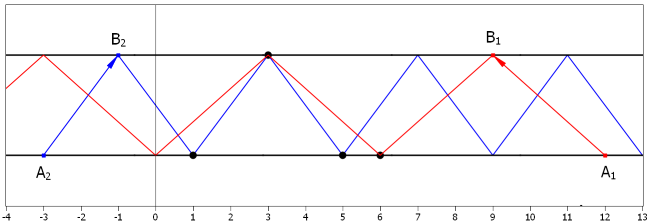Examples of laser rays. Note that image contains two examples. The $ 3 $ sensors (denoted by black bold points on the tube sides) will register the blue ray but only $ 2 $ will register the red.Calculate the maximum number of sensors which can register your ray if you choose points $ A $ and $ B $ on the first and the second lines respectively.
Input Format
The first line contains two integers $ n $ and $ y_1 $ ( $ 1 \le n \le 10^5 $ , $ 0 \le y_1 \le 10^9 $ ) — number of sensors on the first line and its $ y $ coordinate.
The second line contains $ n $ integers $ a_1, a_2, \ldots, a_n $ ( $ 0 \le a_i \le 10^9 $ ) — $ x $ coordinates of the sensors on the first line in the ascending order.
The third line contains two integers $ m $ and $ y_2 $ ( $ 1 \le m \le 10^5 $ , $ y_1 < y_2 \le 10^9 $ ) — number of sensors on the second line and its $ y $ coordinate.
The fourth line contains $ m $ integers $ b_1, b_2, \ldots, b_m $ ( $ 0 \le b_i \le 10^9 $ ) — $ x $ coordinates of the sensors on the second line in the ascending order.
Output Format
Print the only integer — the maximum number of sensors which can register the ray.
Explanation/Hint
One of the solutions illustrated on the image by pair $ A_2 $ and $ B_2 $ .