CF1200C Round Corridor
Description
Amugae is in a very large round corridor. The corridor consists of two areas. The inner area is equally divided by $ n $ sectors, and the outer area is equally divided by $ m $ sectors. A wall exists between each pair of sectors of same area (inner or outer), but there is no wall between the inner area and the outer area. A wall always exists at the 12 o'clock position.
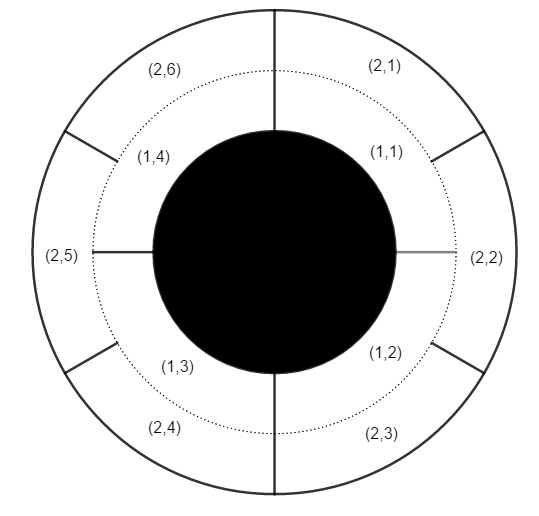The inner area's sectors are denoted as $ (1,1), (1,2), \dots, (1,n) $ in clockwise direction. The outer area's sectors are denoted as $ (2,1), (2,2), \dots, (2,m) $ in the same manner. For a clear understanding, see the example image above.
Amugae wants to know if he can move from one sector to another sector. He has $ q $ questions.
For each question, check if he can move between two given sectors.
Input Format
The first line contains three integers $ n $ , $ m $ and $ q $ ( $ 1 \le n, m \le 10^{18} $ , $ 1 \le q \le 10^4 $ ) — the number of sectors in the inner area, the number of sectors in the outer area and the number of questions.
Each of the next $ q $ lines contains four integers $ s_x $ , $ s_y $ , $ e_x $ , $ e_y $ ( $ 1 \le s_x, e_x \le 2 $ ; if $ s_x = 1 $ , then $ 1 \le s_y \le n $ , otherwise $ 1 \le s_y \le m $ ; constraints on $ e_y $ are similar). Amague wants to know if it is possible to move from sector $ (s_x, s_y) $ to sector $ (e_x, e_y) $ .
Output Format
For each question, print "YES" if Amugae can move from $ (s_x, s_y) $ to $ (e_x, e_y) $ , and "NO" otherwise.
You can print each letter in any case (upper or lower).
Explanation/Hint
Example is shown on the picture in the statement.