CF1205A Almost Equal
Description
You are given integer $ n $ . You have to arrange numbers from $ 1 $ to $ 2n $ , using each of them exactly once, on the circle, so that the following condition would be satisfied:
For every $ n $ consecutive numbers on the circle write their sum on the blackboard. Then any two of written on the blackboard $ 2n $ numbers differ not more than by $ 1 $ .
For example, choose $ n = 3 $ . On the left you can see an example of a valid arrangement: $ 1 + 4 + 5 = 10 $ , $ 4 + 5 + 2 = 11 $ , $ 5 + 2 + 3 = 10 $ , $ 2 + 3 + 6 = 11 $ , $ 3 + 6 + 1 = 10 $ , $ 6 + 1 + 4 = 11 $ , any two numbers differ by at most $ 1 $ . On the right you can see an invalid arrangement: for example, $ 5 + 1 + 6 = 12 $ , and $ 3 + 2 + 4 = 9 $ , $ 9 $ and $ 12 $ differ more than by $ 1 $ .
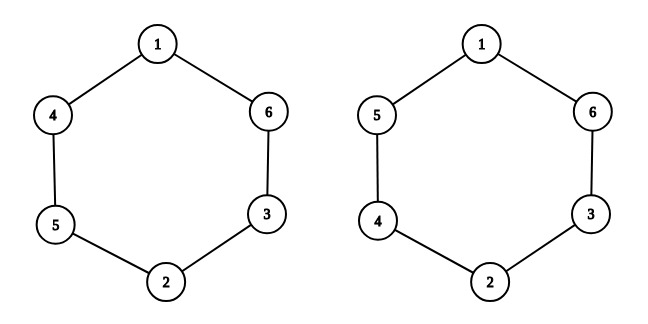
Input Format
The first and the only line contain one integer $ n $ ( $ 1 \le n \le 10^5 $ ).
Output Format
If there is no solution, output "NO" in the first line.
If there is a solution, output "YES" in the first line. In the second line output $ 2n $ numbers — numbers from $ 1 $ to $ 2n $ in the order they will stay in the circle. Each number should appear only once. If there are several solutions, you can output any of them.
Explanation/Hint
Example from the statement is shown for the first example.
It can be proved that there is no solution in the second example.