CF1209B Koala and Lights
Description
It is a holiday season, and Koala is decorating his house with cool lights! He owns $ n $ lights, all of which flash periodically.
After taking a quick glance at them, Koala realizes that each of his lights can be described with two parameters $ a_i $ and $ b_i $ . Light with parameters $ a_i $ and $ b_i $ will toggle (on to off, or off to on) every $ a_i $ seconds starting from the $ b_i $ -th second. In other words, it will toggle at the moments $ b_i $ , $ b_i + a_i $ , $ b_i + 2 \cdot a_i $ and so on.
You know for each light whether it's initially on or off and its corresponding parameters $ a_i $ and $ b_i $ . Koala is wondering what is the maximum number of lights that will ever be on at the same time. So you need to find that out.
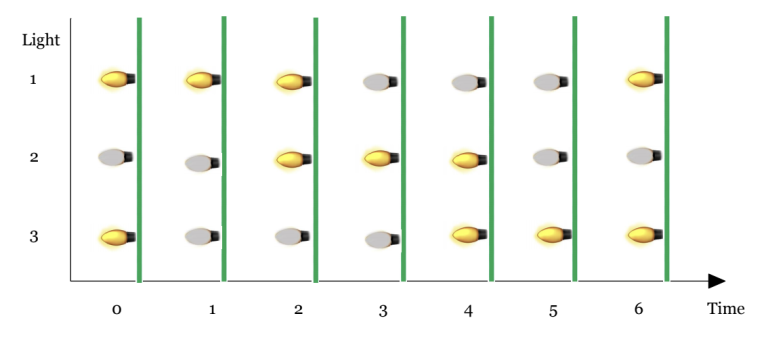Here is a graphic for the first example.
Input Format
The first line contains a single integer $ n $ ( $ 1 \le n \le 100 $ ), the number of lights.
The next line contains a string $ s $ of $ n $ characters. The $ i $ -th character is "1", if the $ i $ -th lamp is initially on. Otherwise, $ i $ -th character is "0".
The $ i $ -th of the following $ n $ lines contains two integers $ a_i $ and $ b_i $ ( $ 1 \le a_i, b_i \le 5 $ ) — the parameters of the $ i $ -th light.
Output Format
Print a single integer — the maximum number of lights that will ever be on at the same time.
Explanation/Hint
For first example, the lamps' states are shown in the picture above. The largest number of simultaneously on lamps is $ 2 $ (e.g. at the moment $ 2 $ ).
In the second example, all lights are initially on. So the answer is $ 4 $ .