CF1213G Path Queries
Description
You are given a weighted tree consisting of $ n $ vertices. Recall that a tree is a connected graph without cycles. Vertices $ u_i $ and $ v_i $ are connected by an edge with weight $ w_i $ .
You are given $ m $ queries. The $ i $ -th query is given as an integer $ q_i $ . In this query you need to calculate the number of pairs of vertices $ (u, v) $ ( $ u < v $ ) such that the maximum weight of an edge on a simple path between $ u $ and $ v $ doesn't exceed $ q_i $ .
Input Format
The first line of the input contains two integers $ n $ and $ m $ ( $ 1 \le n, m \le 2 \cdot 10^5 $ ) — the number of vertices in the tree and the number of queries.
Each of the next $ n - 1 $ lines describes an edge of the tree. Edge $ i $ is denoted by three integers $ u_i $ , $ v_i $ and $ w_i $ — the labels of vertices it connects ( $ 1 \le u_i, v_i \le n $ , $ u_i \ne v_i $ ) and the weight of the edge ( $ 1 \le w_i \le 2 \cdot 10^5 $ ). It is guaranteed that the given edges form a tree.
The last line of the input contains $ m $ integers $ q_1, q_2, \dots, q_m $ ( $ 1 \le q_i \le 2 \cdot 10^5 $ ), where $ q_i $ is the maximum weight of an edge in the $ i $ -th query.
Output Format
Print $ m $ integers — the answers to the queries. The $ i $ -th value should be equal to the number of pairs of vertices $ (u, v) $ ( $ u < v $ ) such that the maximum weight of an edge on a simple path between $ u $ and $ v $ doesn't exceed $ q_i $ .
Queries are numbered from $ 1 $ to $ m $ in the order of the input.
Explanation/Hint
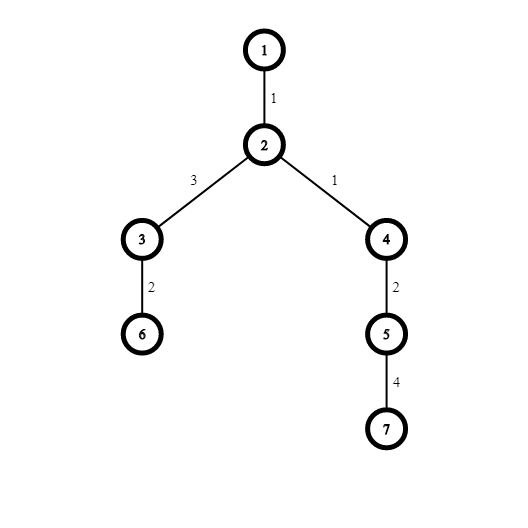
The picture shows the tree from the first example: