CF1228F One Node is Gone
Description
You have an integer $ n $ . Let's define following tree generation as McDic's generation:
1. Make a complete and full binary tree of $ 2^{n} - 1 $ vertices. Complete and full binary tree means a tree that exactly one vertex is a root, all leaves have the same depth (distance from the root), and all non-leaf nodes have exactly two child nodes.
2. Select a non-root vertex $ v $ from that binary tree.
3. Remove $ v $ from tree and make new edges between $ v $ 's parent and $ v $ 's direct children. If $ v $ has no children, then no new edges will be made.
You have a tree. Determine if this tree can be made by McDic's generation. If yes, then find the parent vertex of removed vertex in tree.
Input Format
The first line contains integer $ n $ ( $ 2 \le n \le 17 $ ).
The $ i $ -th of the next $ 2^{n} - 3 $ lines contains two integers $ a_{i} $ and $ b_{i} $ ( $ 1 \le a_{i} \lt b_{i} \le 2^{n} - 2 $ ) — meaning there is an edge between $ a_{i} $ and $ b_{i} $ . It is guaranteed that the given edges form a tree.
Output Format
Print two lines.
In the first line, print a single integer — the number of answers. If given tree cannot be made by McDic's generation, then print $ 0 $ .
In the second line, print all possible answers in ascending order, separated by spaces. If the given tree cannot be made by McDic's generation, then don't print anything.
Explanation/Hint
In the first example, $ 3 $ is the only possible answer.
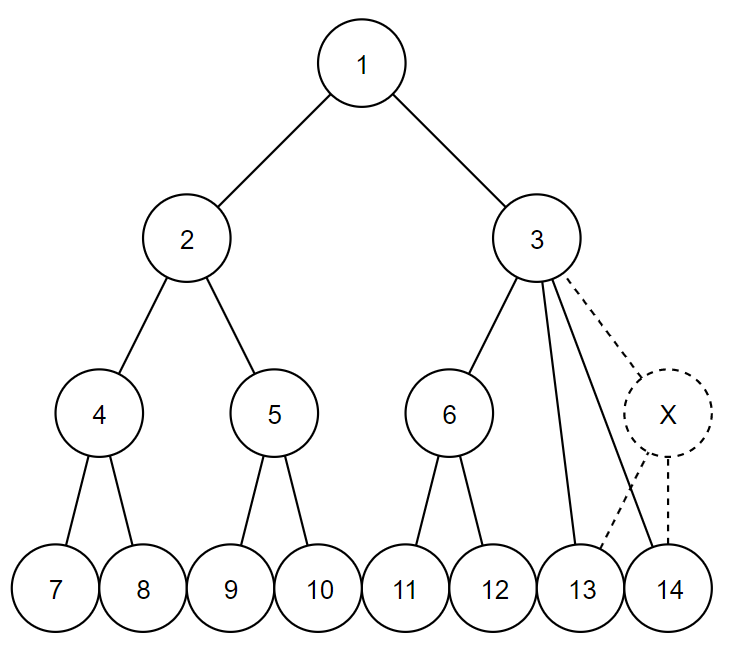In the second example, there are $ 2 $ possible answers.
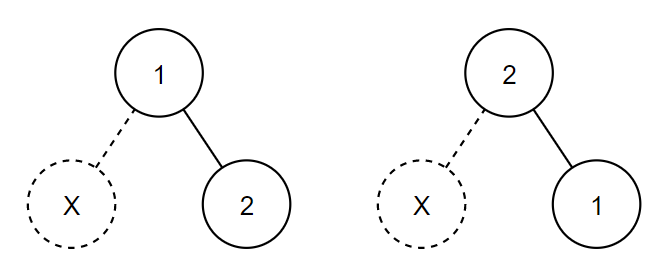In the third example, the tree can't be generated by McDic's generation.