CF1242E Planar Perimeter
Description
Ujan has finally cleaned up his house and now wants to decorate the interior. He decided to place a beautiful carpet that would really tie the guest room together.
He is interested in carpets that are made up of polygonal patches such that each side of a patch is either a side of another (different) patch, or is an exterior side of the whole carpet. In other words, the carpet can be represented as a planar graph, where each patch corresponds to a face of the graph, each face is a simple polygon. The perimeter of the carpet is the number of the exterior sides.
Ujan considers a carpet beautiful if it consists of $ f $ patches, where the $ i $ -th patch has exactly $ a_i $ sides, and the perimeter is the smallest possible. Find an example of such a carpet, so that Ujan can order it!
Input Format
The first line of input contains a single integer $ f $ ( $ 1 \leq f \leq 10^5 $ ), the number of patches in the carpet.
The next line contains $ f $ integers $ a_1, \ldots, a_f $ ( $ 3 \leq a_i \leq 3\cdot 10^5 $ ), the number of sides of the patches. The total number of the sides of the patches $ a_1 + \ldots + a_f $ does not exceed $ 3\cdot10^5 $ .
Output Format
Output the description of the carpet as a graph.
First, output a single integer $ n $ ( $ 3 \leq n \leq 3 \cdot 10^5 $ ), the total number of vertices in your graph (the vertices must be numbered from $ 1 $ to $ n $ ).
Then output $ f $ lines containing the description of the faces. The $ i $ -th line should describe the $ i $ -th face and contain $ a_i $ distinct integers $ v_{i,1}, \ldots, v_{i,a_i} $ ( $ 1 \leq v_{i,j} \leq n $ ), which means that the vertices $ v_{i,j} $ and $ v_{i,(j \bmod{a_i})+1} $ are connected by an edge for any $ 1 \leq j \leq a_i $ .
The graph should be planar and satisfy the restrictions described in the problem statement. Its perimeter should be the smallest possible. There should be no double edges or self-loops in the graph. The graph should be connected. Note that a solution always exists; if there are multiple solutions, output any of them.
Explanation/Hint
In the first sample, the two triangular faces are connected by a single edge, which results in the minimum perimeter $ 4 $ .
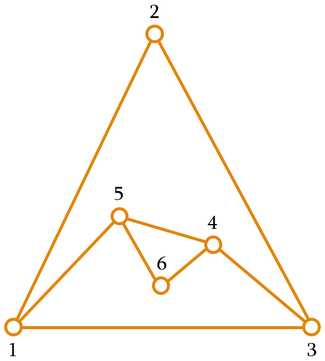
The figure shows one possible configuration for the second sample. The minimum perimeter in this case is $ 3 $ .