CF1428H Rotary Laser Lock
题目描述
为了防止这些顽皮的兔子在动物园里自由游荡,动物园管理员为兔子圈设置了一个特殊的锁。这种锁叫做旋转激光锁。
- 锁由编号为 $0$ 到 $n−1$ 的 $n$ 个同心环组成。最里面的环是环 $0$,最外面的环是环 $n−1$。
- 所有环平均分成 $n\times m$ 部分。这些环中的每一个都包含一个金属圆弧,正好覆盖了 $m$ 个相邻的部分。
- 在环的中心是一个核心。有 $n\times m$ 接收器围绕着整个锁,对准 $n\times m$ 个部分。
- 核心有 $n\times m$ 个激光器,从中心中的每个部分向外照射。激光可以被任何一个电弧阻挡。锁外面的显示屏显示有多少激光击中了外部接收器。
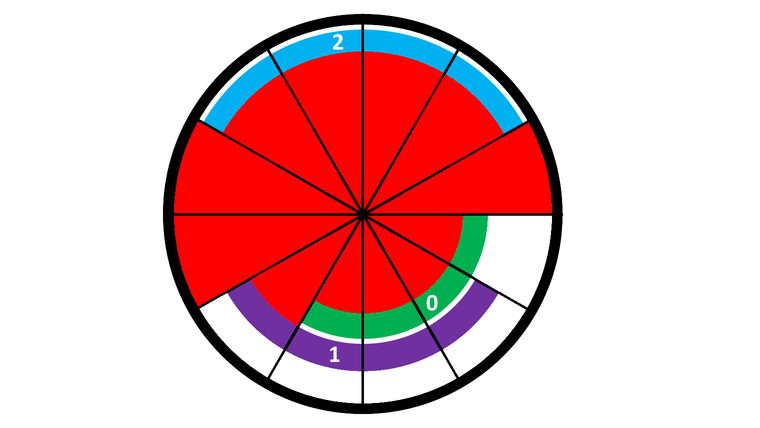
(见上图)
在上例中,有 $n=3$ 个环,每个环覆盖 $m=4$ 个截面。弧线的颜色为绿色(环 $0$ )、紫色(环 $1$ )和蓝色(环$2$ ),而激光束显示为红色。
有 $n\times m=12$ 段,$3$ 个激光器没有被任何弧光阻挡,因此在这种情况下显示器将显示 $3$。
Wabbit 试图打开锁释放兔子,但锁是完全不透明的,他看不见任何弧线在哪里。如果给出弧的相对位置,Wabbit 可以自己打开锁。
准确地说,Wabbit需要 $n-1$ 个整数 $p_1,p_2,\ldots,p_{n-1}$ 作为相对位置,满足对于任意的 $1\leqslant i< n$,有 $0 \leqslant p_i\leqslant n\times m$。
Wabbit 要顺时针旋转环 $0$ 恰好 $p_i$ 次,使环 $0$ 覆盖的部分与环 $i$ 覆盖的部分完全对齐。
在上面的例子中,相对位置 $p_1=1,p_2=7$。
他可以选择 $n$ 个环中的任意一个,并将其顺时针或逆时针旋转 $1$ 段。每次旋转后,您将在显示屏上看到数字。
因为 Wabbit 的爪子很小,他让你帮他找到他所有的位置。在 Wabbit 失去耐心之前,你可以让他旋转最多 $15000$ 次。
输入格式
第一行包含两个整数 $n$ 和 $m$ $(2\leqslant n \leqslant 100,2\leqslant m \leqslant 20)$,表示环的数量和每个环覆盖的部分的数量。
输出格式
要执行旋转,请在输出一行 ``? x d``,满足 $(0\leqslant x
说明/提示
在第一组数据中,初始局面与题意中的图片相同。
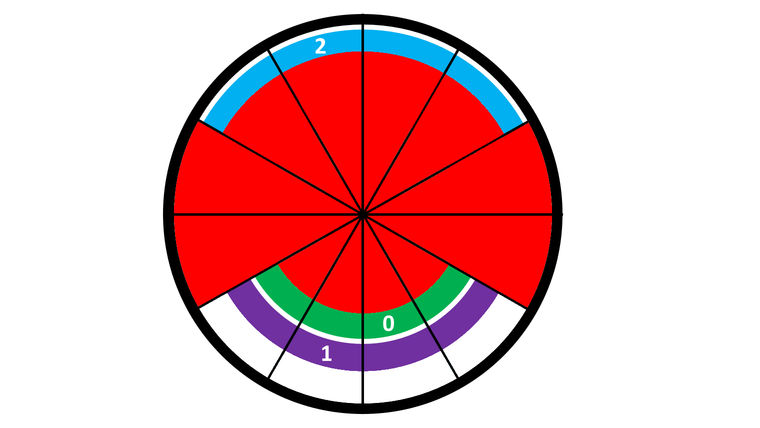
在第一次旋转后(将第 $0$ 个环顺时针旋转了 $1$ 段),局面变成:
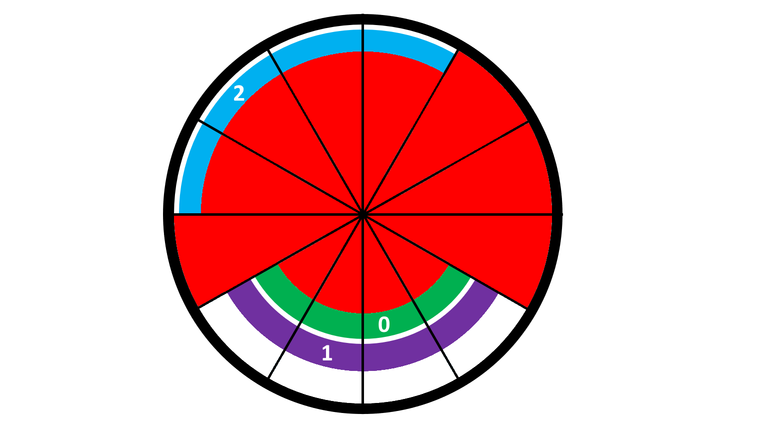
在第二次旋转后(将第 $2$ 个环逆时针旋转了 $1$ 段),局面变成:
在第三次旋转后(将第 $1$ 个环顺时针旋转了 $1$ 段),局面变成:
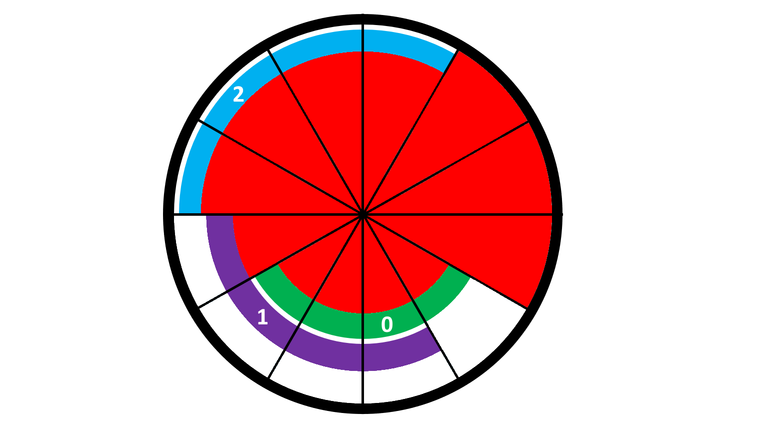
如果我们将第 $0$ 个环顺时针旋转 $1$ 段,则它完全与第 $1$ 个环重合,所以 $p_1=1$。
如果我们将第 $0$ 个环顺时针旋转 $5$ 段,则它完全与第 $2$ 个环重合,所以 $p_2=5$。
注意,如果我们执行的旋转操作不同,则最终的 $p_1$ 和 $p_2$ 也可能不同。