CF1462A Favorite Sequence
Description
Polycarp has a favorite sequence $ a[1 \dots n] $ consisting of $ n $ integers. He wrote it out on the whiteboard as follows:
- he wrote the number $ a_1 $ to the left side (at the beginning of the whiteboard);
- he wrote the number $ a_2 $ to the right side (at the end of the whiteboard);
- then as far to the left as possible (but to the right from $ a_1 $ ), he wrote the number $ a_3 $ ;
- then as far to the right as possible (but to the left from $ a_2 $ ), he wrote the number $ a_4 $ ;
- Polycarp continued to act as well, until he wrote out the entire sequence on the whiteboard.
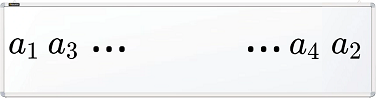The beginning of the result looks like this (of course, if $ n \ge 4 $ ).For example, if $ n=7 $ and $ a=[3, 1, 4, 1, 5, 9, 2] $ , then Polycarp will write a sequence on the whiteboard $ [3, 4, 5, 2, 9, 1, 1] $ .
You saw the sequence written on the whiteboard and now you want to restore Polycarp's favorite sequence.
Input Format
The first line contains a single positive integer $ t $ ( $ 1 \le t \le 300 $ ) — the number of test cases in the test. Then $ t $ test cases follow.
The first line of each test case contains an integer $ n $ ( $ 1 \le n \le 300 $ ) — the length of the sequence written on the whiteboard.
The next line contains $ n $ integers $ b_1, b_2,\ldots, b_n $ ( $ 1 \le b_i \le 10^9 $ ) — the sequence written on the whiteboard.
Output Format
Output $ t $ answers to the test cases. Each answer — is a sequence $ a $ that Polycarp wrote out on the whiteboard.
Explanation/Hint
In the first test case, the sequence $ a $ matches the sequence from the statement. The whiteboard states after each step look like this:
$ [3] \Rightarrow [3, 1] \Rightarrow [3, 4, 1] \Rightarrow [3, 4, 1, 1] \Rightarrow [3, 4, 5, 1, 1] \Rightarrow [3, 4, 5, 9, 1, 1] \Rightarrow [3, 4, 5, 2, 9, 1, 1] $ .