CF1481F AB Tree
Description
Kilani and Abd are neighbors for 3000 years, but then the day came and Kilani decided to move to another house. As a farewell gift, Kilani is going to challenge Abd with a problem written by their other neighbor with the same name Abd.
The problem is:
You are given a connected tree rooted at node $ 1 $ .
You should assign a character a or b to every node in the tree so that the total number of a's is equal to $ x $ and the total number of b's is equal to $ n - x $ .
Let's define a string for each node $ v $ of the tree as follows:
- if $ v $ is root then the string is just one character assigned to $ v $ :
- otherwise, let's take a string defined for the $ v $ 's parent $ p_v $ and add to the end of it a character assigned to $ v $ .
You should assign every node a character in a way that minimizes the number of distinct strings among the strings of all nodes.
Input Format
The first line contains two integers $ n $ and $ x $ ( $ 1 \leq n \leq 10^5 $ ; $ 0 \leq x \leq n $ ) — the number of vertices in the tree the number of a's.
The second line contains $ n - 1 $ integers $ p_2, p_3, \dots, p_{n} $ ( $ 1 \leq p_i \leq n $ ; $ p_i \neq i $ ), where $ p_i $ is the parent of node $ i $ .
It is guaranteed that the input describes a connected tree.
Output Format
In the first line, print the minimum possible total number of distinct strings.
In the second line, print $ n $ characters, where all characters are either a or b and the $ i $ -th character is the character assigned to the $ i $ -th node.
Make sure that the total number of a's is equal to $ x $ and the total number of b's is equal to $ n - x $ .
If there is more than one answer you can print any of them.
Explanation/Hint
The tree from the sample is shown below:
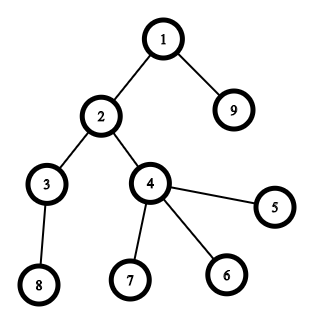The tree after assigning characters to every node (according to the output) is the following:
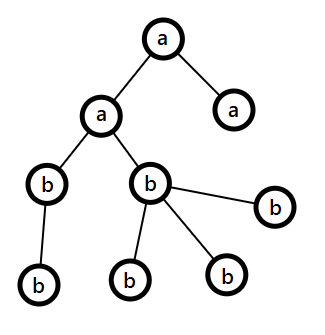Strings for all nodes are the following:
- string of node $ 1 $ is: a
- string of node $ 2 $ is: aa
- string of node $ 3 $ is: aab
- string of node $ 4 $ is: aab
- string of node $ 5 $ is: aabb
- string of node $ 6 $ is: aabb
- string of node $ 7 $ is: aabb
- string of node $ 8 $ is: aabb
- string of node $ 9 $ is: aa
The set of unique strings is $ \{\text{a}, \text{aa}, \text{aab}, \text{aabb}\} $ , so the number of distinct strings is $ 4 $ .