CF1491B Minimal Cost
Description
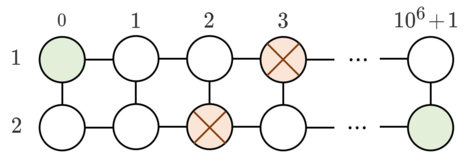
There is a graph of $ n $ rows and $ 10^6 + 2 $ columns, where rows are numbered from $ 1 $ to $ n $ and columns from $ 0 $ to $ 10^6 + 1 $ :
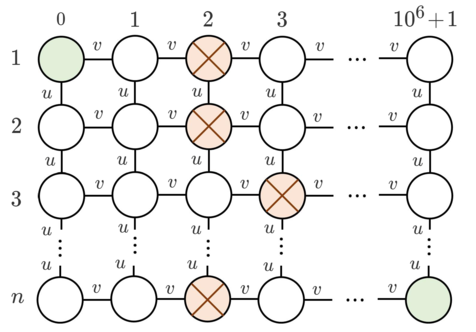Let's denote the node in the row $ i $ and column $ j $ by $ (i, j) $ .
Initially for each $ i $ the $ i $ -th row has exactly one obstacle — at node $ (i, a_i) $ . You want to move some obstacles so that you can reach node $ (n, 10^6+1) $ from node $ (1, 0) $ by moving through edges of this graph (you can't pass through obstacles). Moving one obstacle to an adjacent by edge free node costs $ u $ or $ v $ coins, as below:
- If there is an obstacle in the node $ (i, j) $ , you can use $ u $ coins to move it to $ (i-1, j) $ or $ (i+1, j) $ , if such node exists and if there is no obstacle in that node currently.
- If there is an obstacle in the node $ (i, j) $ , you can use $ v $ coins to move it to $ (i, j-1) $ or $ (i, j+1) $ , if such node exists and if there is no obstacle in that node currently.
- Note that you can't move obstacles outside the grid. For example, you can't move an obstacle from $ (1,1) $ to $ (0,1) $ .
Refer to the picture above for a better understanding.
Now you need to calculate the minimal number of coins you need to spend to be able to reach node $ (n, 10^6+1) $ from node $ (1, 0) $ by moving through edges of this graph without passing through obstacles.
Input Format
The first line contains a single integer $ t $ ( $ 1 \le t \le 10^4 $ ) — the number of test cases.
The first line of each test case contains three integers $ n $ , $ u $ and $ v $ ( $ 2 \le n \le 100 $ , $ 1 \le u, v \le 10^9 $ ) — the number of rows in the graph and the numbers of coins needed to move vertically and horizontally respectively.
The second line of each test case contains $ n $ integers $ a_1, a_2, \dots, a_n $ ( $ 1 \le a_i \le 10^6 $ ) — where $ a_i $ represents that the obstacle in the $ i $ -th row is in node $ (i, a_i) $ .
It's guaranteed that the sum of $ n $ over all test cases doesn't exceed $ 2 \cdot 10^4 $ .
Output Format
For each test case, output a single integer — the minimal number of coins you need to spend to be able to reach node $ (n, 10^6+1) $ from node $ (1, 0) $ by moving through edges of this graph without passing through obstacles.
It can be shown that under the constraints of the problem there is always a way to make such a trip possible.
Explanation/Hint
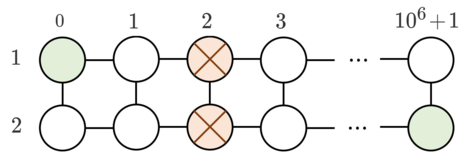
In the first sample, two obstacles are at $ (1, 2) $ and $ (2,2) $ . You can move the obstacle on $ (2, 2) $ to $ (2, 3) $ , then to $ (1, 3) $ . The total cost is $ u+v = 7 $ coins.
In the second sample, two obstacles are at $ (1, 3) $ and $ (2,2) $ . You can move the obstacle on $ (1, 3) $ to $ (2, 3) $ . The cost is $ u = 3 $ coins.