CF1537F Figure Fixing
Description
You have a connected undirected graph made of $ n $ nodes and $ m $ edges. The $ i $ -th node has a value $ v_i $ and a target value $ t_i $ .
In an operation, you can choose an edge $ (i, j) $ and add $ k $ to both $ v_i $ and $ v_j $ , where $ k $ can be any integer. In particular, $ k $ can be negative.
Your task to determine if it is possible that by doing some finite number of operations (possibly zero), you can achieve for every node $ i $ , $ v_i = t_i $ .
Input Format
The first line contains a single integer $ t $ ( $ 1 \leq t \leq 1000 $ ), the number of test cases. Then the test cases follow.
The first line of each test case contains two integers $ n $ , $ m $ ( $ 2 \leq n \leq 2\cdot 10^5 $ , $ n-1\leq m\leq \min(2\cdot 10^5, \frac{n(n-1)}{2}) $ ) — the number of nodes and edges respectively.
The second line contains $ n $ integers $ v_1\ldots, v_n $ ( $ -10^9 \leq v_i \leq 10^9 $ ) — initial values of nodes.
The third line contains $ n $ integers $ t_1\ldots, t_n $ ( $ -10^9 \leq t_i \leq 10^9 $ ) — target values of nodes.
Each of the next $ m $ lines contains two integers $ i $ and $ j $ representing an edge between node $ i $ and node $ j $ ( $ 1 \leq i, j \leq n $ , $ i\ne j $ ).
It is guaranteed that the graph is connected and there is at most one edge between the same pair of nodes.
It is guaranteed that the sum of $ n $ over all testcases does not exceed $ 2 \cdot 10^5 $ and the sum of $ m $ over all testcases does not exceed $ 2 \cdot 10^5 $ .
Output Format
For each test case, if it is possible for every node to reach its target after some number of operations, print "YES". Otherwise, print "NO".
Explanation/Hint
Here is a visualization of the first test case (the orange values denote the initial values and the blue ones the desired values):
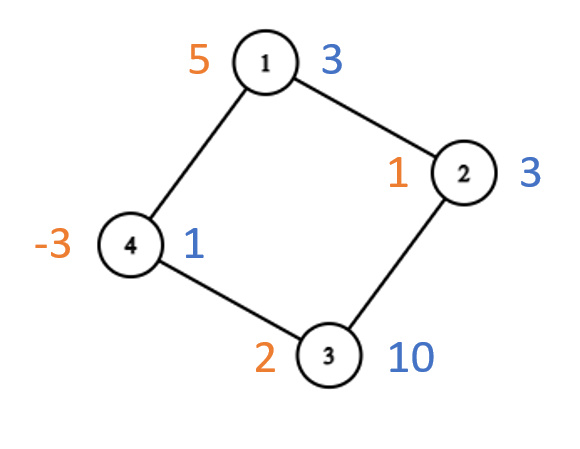One possible order of operations to obtain the desired values for each node is the following:
- Operation $ 1 $ : Add $ 2 $ to nodes $ 2 $ and $ 3 $ .
- Operation $ 2 $ : Add $ -2 $ to nodes $ 1 $ and $ 4 $ .
- Operation $ 3 $ : Add $ 6 $ to nodes $ 3 $ and $ 4 $ .
Now we can see that in total we added $ -2 $ to node $ 1 $ , $ 2 $ to node $ 2 $ , $ 8 $ to node $ 3 $ and $ 4 $ to node $ 4 $ which brings each node exactly to it's desired value.
For the graph from the second test case it's impossible to get the target values.