CF1627A Not Shading
Description
There is a grid with $ n $ rows and $ m $ columns. Some cells are colored black, and the rest of the cells are colored white.
In one operation, you can select some black cell and do exactly one of the following:
- color all cells in its row black, or
- color all cells in its column black.
You are given two integers $ r $ and $ c $ . Find the minimum number of operations required to make the cell in row $ r $ and column $ c $ black, or determine that it is impossible.
Input Format
The input consists of multiple test cases. The first line contains an integer $ t $ ( $ 1 \leq t \leq 100 $ ) — the number of test cases. The description of the test cases follows.
The first line of each test case contains four integers $ n $ , $ m $ , $ r $ , and $ c $ ( $ 1 \leq n, m \leq 50 $ ; $ 1 \leq r \leq n $ ; $ 1 \leq c \leq m $ ) — the number of rows and the number of columns in the grid, and the row and column of the cell you need to turn black, respectively.
Then $ n $ lines follow, each containing $ m $ characters. Each of these characters is either 'B' or 'W' — a black and a white cell, respectively.
Output Format
For each test case, if it is impossible to make the cell in row $ r $ and column $ c $ black, output $ -1 $ .
Otherwise, output a single integer — the minimum number of operations required to make the cell in row $ r $ and column $ c $ black.
Explanation/Hint
The first test case is pictured below.
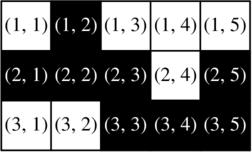We can take the black cell in row $ 1 $ and column $ 2 $ , and make all cells in its row black. Therefore, the cell in row $ 1 $ and column $ 4 $ will become black.
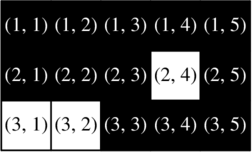In the second test case, the cell in row $ 2 $ and column $ 1 $ is already black.
In the third test case, it is impossible to make the cell in row $ 2 $ and column $ 2 $ black.
The fourth test case is pictured below.
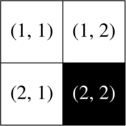We can take the black cell in row $ 2 $ and column $ 2 $ and make its column black.
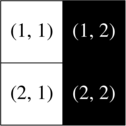Then, we can take the black cell in row $ 1 $ and column $ 2 $ and make its row black.
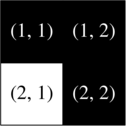Therefore, the cell in row $ 1 $ and column $ 1 $ will become black.