CF1627C Not Assigning
Description
You are given a tree of $ n $ vertices numbered from $ 1 $ to $ n $ , with edges numbered from $ 1 $ to $ n-1 $ . A tree is a connected undirected graph without cycles. You have to assign integer weights to each edge of the tree, such that the resultant graph is a prime tree.
A prime tree is a tree where the weight of every path consisting of one or two edges is prime. A path should not visit any vertex twice. The weight of a path is the sum of edge weights on that path.
Consider the graph below. It is a prime tree as the weight of every path of two or less edges is prime. For example, the following path of two edges: $ 2 \to 1 \to 3 $ has a weight of $ 11 + 2 = 13 $ , which is prime. Similarly, the path of one edge: $ 4 \to 3 $ has a weight of $ 5 $ , which is also prime.
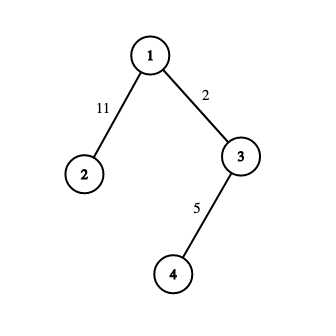Print any valid assignment of weights such that the resultant tree is a prime tree. If there is no such assignment, then print $ -1 $ . It can be proven that if a valid assignment exists, one exists with weights between $ 1 $ and $ 10^5 $ as well.
Input Format
The input consists of multiple test cases. The first line contains an integer $ t $ ( $ 1 \leq t \leq 10^4 $ ) — the number of test cases. The description of the test cases follows.
The first line of each test case contains one integer $ n $ ( $ 2 \leq n \leq 10^5 $ ) — the number of vertices in the tree.
Then, $ n-1 $ lines follow. The $ i $ -th line contains two integers $ u $ and $ v $ ( $ 1 \leq u, v \leq n $ ) denoting that edge number $ i $ is between vertices $ u $ and $ v $ . It is guaranteed that the edges form a tree.
It is guaranteed that the sum of $ n $ over all test cases does not exceed $ 10^5 $ .
Output Format
For each test case, if a valid assignment exists, then print a single line containing $ n-1 $ integers $ a_1, a_2, \dots, a_{n-1} $ ( $ 1 \leq a_i \le 10^5 $ ), where $ a_i $ denotes the weight assigned to the edge numbered $ i $ . Otherwise, print $ -1 $ .
If there are multiple solutions, you may print any.
Explanation/Hint
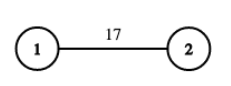
For the first test case, there are only two paths having one edge each: $ 1 \to 2 $ and $ 2 \to 1 $ , both having a weight of $ 17 $ , which is prime.
The second test case is described in the statement.
It can be proven that no such assignment exists for the third test case.