CF1646E Power Board
Description
You have a rectangular board of size $ n\times m $ ( $ n $ rows, $ m $ columns). The $ n $ rows are numbered from $ 1 $ to $ n $ from top to bottom, and the $ m $ columns are numbered from $ 1 $ to $ m $ from left to right.
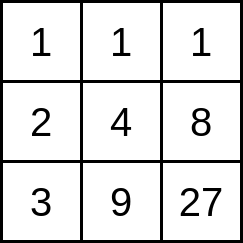
The cell at the intersection of row $ i $ and column $ j $ contains the number $ i^j $ ( $ i $ raised to the power of $ j $ ). For example, if $ n=3 $ and $ m=3 $ the board is as follows:
Find the number of distinct integers written on the board.
Input Format
The only line contains two integers $ n $ and $ m $ ( $ 1\le n,m\le 10^6 $ ) — the number of rows and columns of the board.
Output Format
Print one integer, the number of distinct integers on the board.
Explanation/Hint
The statement shows the board for the first test case. In this case there are $ 7 $ distinct integers: $ 1 $ , $ 2 $ , $ 3 $ , $ 4 $ , $ 8 $ , $ 9 $ , and $ 27 $ .
In the second test case, the board is as follows:
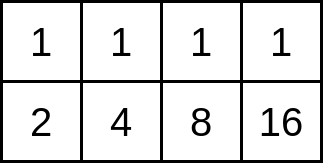There are $ 5 $ distinct numbers: $ 1 $ , $ 2 $ , $ 4 $ , $ 8 $ and $ 16 $ .
In the third test case, the board is as follows:
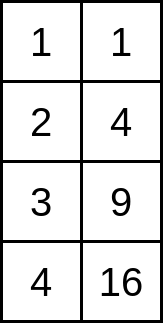There are $ 6 $ distinct numbers: $ 1 $ , $ 2 $ , $ 3 $ , $ 4 $ , $ 9 $ and $ 16 $ .