CF1666J Job Lookup
Description
Julia's $ n $ friends want to organize a startup in a new country they moved to. They assigned each other numbers from 1 to $ n $ according to the jobs they have, from the most front-end tasks to the most back-end ones. They also estimated a matrix $ c $ , where $ c_{ij} = c_{ji} $ is the average number of messages per month between people doing jobs $ i $ and $ j $ .
Now they want to make a hierarchy tree. It will be a binary tree with each node containing one member of the team. Some member will be selected as a leader of the team and will be contained in the root node. In order for the leader to be able to easily reach any subordinate, for each node $ v $ of the tree, the following should apply: all members in its left subtree must have smaller numbers than $ v $ , and all members in its right subtree must have larger numbers than $ v $ .
After the hierarchy tree is settled, people doing jobs $ i $ and $ j $ will be communicating via the shortest path in the tree between their nodes. Let's denote the length of this path as $ d_{ij} $ . Thus, the cost of their communication is $ c_{ij} \cdot d_{ij} $ .
Your task is to find a hierarchy tree that minimizes the total cost of communication over all pairs: $ \sum_{1 \le i < j \le n} c_{ij} \cdot d_{ij} $ .
Input Format
The first line contains an integer $ n $ ( $ 1 \le n \le 200 $ ) – the number of team members organizing a startup.
The next $ n $ lines contain $ n $ integers each, $ j $ -th number in $ i $ -th line is $ c_{ij} $ — the estimated number of messages per month between team members $ i $ and $ j $ ( $ 0 \le c_{ij} \le 10^9; c_{ij} = c_{ji}; c_{ii} = 0 $ ).
Output Format
Output a description of a hierarchy tree that minimizes the total cost of communication. To do so, for each team member from 1 to $ n $ output the number of the member in its parent node, or 0 for the leader. If there are many optimal trees, output a description of any one of them.
Explanation/Hint
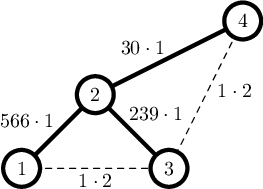
The minimal possible total cost is $ 566 \cdot 1+239 \cdot 1+30 \cdot 1+1 \cdot 2+1 \cdot 2=839 $ :