CF1699B Almost Ternary Matrix
Description
You are given two even integers $ n $ and $ m $ . Your task is to find any binary matrix $ a $ with $ n $ rows and $ m $ columns where every cell $ (i,j) $ has exactly two neighbours with a different value than $ a_{i,j} $ .
Two cells in the matrix are considered neighbours if and only if they share a side. More formally, the neighbours of cell $ (x,y) $ are: $ (x-1,y) $ , $ (x,y+1) $ , $ (x+1,y) $ and $ (x,y-1) $ .
It can be proven that under the given constraints, an answer always exists.
Input Format
Each test contains multiple test cases. The first line of input contains a single integer $ t $ ( $ 1 \le t \le 100 $ ) — the number of test cases. The following lines contain the descriptions of the test cases.
The only line of each test case contains two even integers $ n $ and $ m $ ( $ 2 \le n,m \le 50 $ ) — the height and width of the binary matrix, respectively.
Output Format
For each test case, print $ n $ lines, each of which contains $ m $ numbers, equal to $ 0 $ or $ 1 $ — any binary matrix which satisfies the constraints described in the statement.
It can be proven that under the given constraints, an answer always exists.
Explanation/Hint
White means $ 0 $ , black means $ 1 $ .
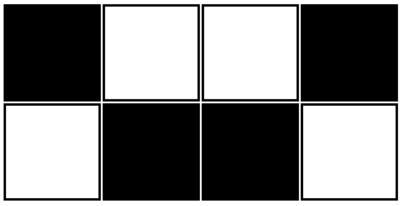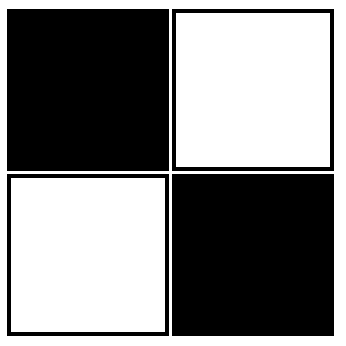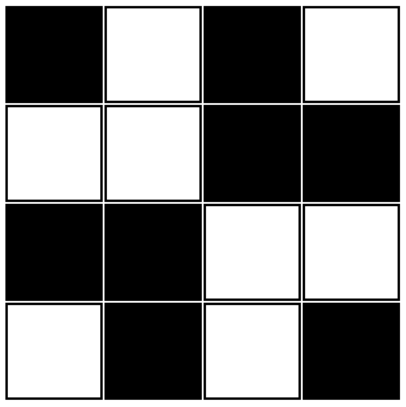The binary matrix from the first test caseThe binary matrix from the second test caseThe binary matrix from the third test case