CF1700A Optimal Path
Description
You are given a table $ a $ of size $ n \times m $ . We will consider the table rows numbered from top to bottom from $ 1 $ to $ n $ , and the columns numbered from left to right from $ 1 $ to $ m $ . We will denote a cell that is in the $ i $ -th row and in the $ j $ -th column as $ (i, j) $ . In the cell $ (i, j) $ there is written a number $ (i - 1) \cdot m + j $ , that is $ a_{ij} = (i - 1) \cdot m + j $ .
A turtle initially stands in the cell $ (1, 1) $ and it wants to come to the cell $ (n, m) $ . From the cell $ (i, j) $ it can in one step go to one of the cells $ (i + 1, j) $ or $ (i, j + 1) $ , if it exists. A path is a sequence of cells in which for every two adjacent in the sequence cells the following satisfies: the turtle can reach from the first cell to the second cell in one step. A cost of a path is the sum of numbers that are written in the cells of the path.
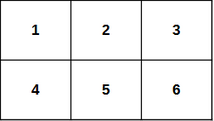For example, with $ n = 2 $ and $ m = 3 $ the table will look as shown above. The turtle can take the following path: $ (1, 1) \rightarrow (1, 2) \rightarrow (1, 3) \rightarrow (2, 3) $ . The cost of such way is equal to $ a_{11} + a_{12} + a_{13} + a_{23} = 12 $ . On the other hand, the paths $ (1, 1) \rightarrow (1, 2) \rightarrow (2, 2) \rightarrow (2, 1) $ and $ (1, 1) \rightarrow (1, 3) $ are incorrect, because in the first path the turtle can't make a step $ (2, 2) \rightarrow (2, 1) $ , and in the second path it can't make a step $ (1, 1) \rightarrow (1, 3) $ .
You are asked to tell the turtle a minimal possible cost of a path from the cell $ (1, 1) $ to the cell $ (n, m) $ . Please note that the cells $ (1, 1) $ and $ (n, m) $ are a part of the way.
Input Format
The first line contains a single integer $ t $ ( $ 1 \leq t \leq 1000 $ ) — the number of test cases. The description of test cases follows.
A single line of each test case contains two integers $ n $ and $ m $ ( $ 1 \leq n, m \leq 10^4 $ ) — the number of rows and columns of the table $ a $ respectively.
Output Format
For each test case output a single integer — a minimal possible cost of a path from the cell $ (1, 1) $ to the cell $ (n, m) $ .
Explanation/Hint
In the first test case the only possible path consists of a single cell $ (1, 1) $ .
The path with the minimal cost in the second test case is shown in the statement.
In the fourth and the fifth test cases there is only one path from $ (1, 1) $ to $ (n, m) $ . Both paths visit every cell in the table.