CF1763E Node Pairs
Description
Let's call an ordered pair of nodes $ (u, v) $ in a directed graph unidirectional if $ u \neq v $ , there exists a path from $ u $ to $ v $ , and there are no paths from $ v $ to $ u $ .
A directed graph is called $ p $ -reachable if it contains exactly $ p $ ordered pairs of nodes $ (u, v) $ such that $ u < v $ and $ u $ and $ v $ are reachable from each other. Find the minimum number of nodes required to create a $ p $ -reachable directed graph.
Also, among all such $ p $ -reachable directed graphs with the minimum number of nodes, let $ G $ denote a graph which maximizes the number of unidirectional pairs of nodes. Find this number.
Input Format
The first and only line contains a single integer $ p $ ( $ 0 \le p \le 2 \cdot 10^5 $ ) — the number of ordered pairs of nodes.
Output Format
Print a single line containing two integers — the minimum number of nodes required to create a $ p $ -reachable directed graph, and the maximum number of unidirectional pairs of nodes among all such $ p $ -reachable directed graphs with the minimum number of nodes.
Explanation/Hint
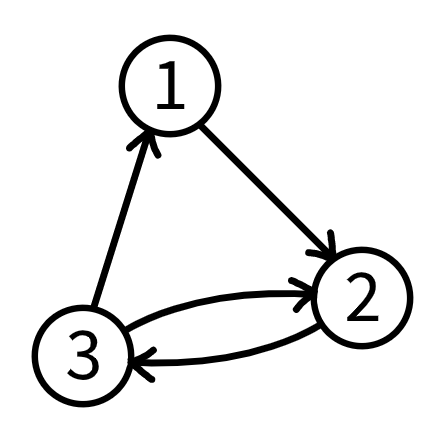
In the first test case, the minimum number of nodes required to create a $ 3 $ -reachable directed graph is $ 3 $ . Among all $ 3 $ -reachable directed graphs with $ 3 $ nodes, the following graph $ G $ is one of the graphs with the maximum number of unidirectional pairs of nodes, which is $ 0 $ .