CF1797F Li Hua and Path
Description
Li Hua has a tree of $ n $ vertices and $ n-1 $ edges. The vertices are numbered from $ 1 $ to $ n $ .
A pair of vertices $ (u,v) $ ( $ u < v $ ) is considered cute if exactly one of the following two statements is true:
- $ u $ is the vertex with the minimum index among all vertices on the path $ (u,v) $ .
- $ v $ is the vertex with the maximum index among all vertices on the path $ (u,v) $ .
There will be $ m $ operations. In each operation, he decides an integer $ k_j $ , then inserts a vertex numbered $ n+j $ to the tree, connecting with the vertex numbered $ k_j $ .
He wants to calculate the number of cute pairs before operations and after each operation.
Suppose you were Li Hua, please solve this problem.
Input Format
The first line contains the single integer $ n $ ( $ 2\le n\le 2\cdot 10^5 $ ) — the number of vertices in the tree.
Next $ n-1 $ lines contain the edges of the tree. The $ i $ -th line contains two integers $ u_i $ and $ v_i $ ( $ 1\le u_i,v_i\le n $ ; $ u_i\ne v_i $ ) — the corresponding edge. The given edges form a tree.
The next line contains the single integer $ m $ ( $ 1\le m\le 2\cdot 10^5 $ ) — the number of operations.
Next $ m $ lines contain operations — one operation per line. The $ j $ -th operation contains one integer $ k_j $ ( $ 1\le k_j < n+j $ ) — a vertex.
Output Format
Print $ m+1 $ integers — the number of cute pairs before operations and after each operation.
Explanation/Hint
The initial tree is shown in the following picture:
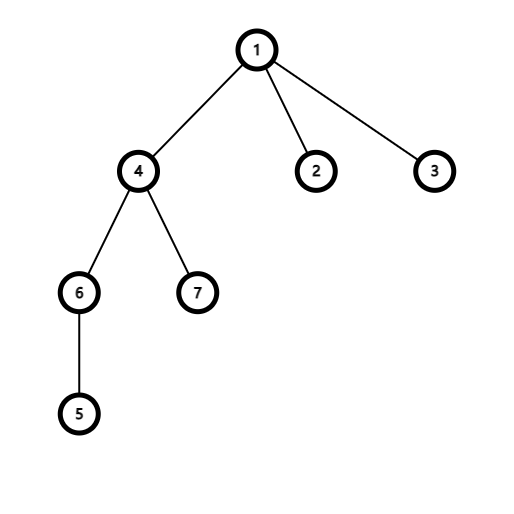There are $ 11 $ cute pairs — $ (1,5),(2,3),(2,4),(2,6),(2,7),(3,4),(3,6),(3,7),(4,5),(5,7),(6,7) $ .
Similarly, we can count the cute pairs after each operation and the result is $ 15 $ and $ 19 $ .