CF183C Cyclic Coloring
Description
You are given a directed graph $ G $ with $ n $ vertices and $ m $ arcs (multiple arcs and self-loops are allowed). You have to paint each vertex of the graph into one of the $ k $ $ (k
Input Format
The first line contains two space-separated integers $ n $ and $ m $ ( $ 1
Output Format
Print a single integer — the maximum possible number of the colors that can be used to paint the digraph (i.e. $ k $ , as described in the problem statement). Note that the desired value of $ k $ must satisfy the inequality $ 1
Explanation/Hint
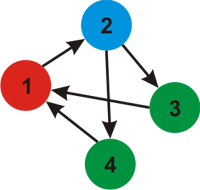
For the first example, with $ k=2 $ , this picture depicts the two colors (arrows denote the next color of that color).
With $ k=2 $ a possible way to paint the graph is as follows.
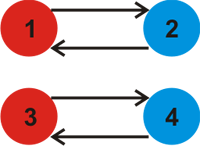It can be proven that no larger value for $ k $ exists for this test case.
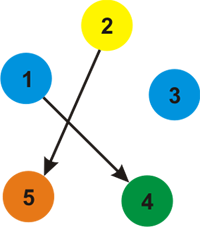
For the second example, here's the picture of the $ k=5 $ colors.
A possible coloring of the graph is:
For the third example, here's the picture of the $ k=3 $ colors.
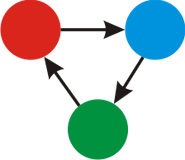A possible coloring of the graph is: