CF1857D Strong Vertices
Description
Given two arrays $ a $ and $ b $ , both of length $ n $ . Elements of both arrays indexed from $ 1 $ to $ n $ . You are constructing a directed graph, where edge from $ u $ to $ v $ ( $ u\neq v $ ) exists if $ a_u-a_v \ge b_u-b_v $ .
A vertex $ V $ is called strong if there exists a path from $ V $ to all other vertices.
A path in a directed graph is a chain of several vertices, connected by edges, such that moving from the vertex $ u $ , along the directions of the edges, the vertex $ v $ can be reached.
Your task is to find all strong vertices.
For example, if $ a=[3,1,2,4] $ and $ b=[4,3,2,1] $ , the graph will look like this:
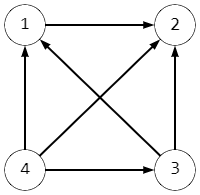 The graph has only one strong vertex with number $ 4 $
Input Format
The first line contains an integer $ t $ ( $ 1\le t\le 10^4 $ ) — the number of test cases.
The first line of each test case contains an integer $ n $ ( $ 2 \le n \le 2\cdot 10^5 $ ) — the length of $ a $ and $ b $ .
The second line of each test case contains $ n $ integers $ a_1,a_2 \dots a_n $ ( $ -10^9 \le a_i \le 10^9 $ ) — the array $ a $ .
The third line of each test case contains $ n $ integers $ b_1,b_2 \dots b_n $ ( $ -10^9 \le b_i \le 10^9 $ ) — the array $ b $ .
It is guaranteed that the sum of $ n $ for all test cases does not exceed $ 2\cdot 10^5 $ .
Output Format
For each test case, output two lines: in the first line, output the number of strong vertices, and in the second line, output all strong vertices in ascending order.
Explanation/Hint
The first sample is covered in the problem statement.
For the second sample, the graph looks like this:
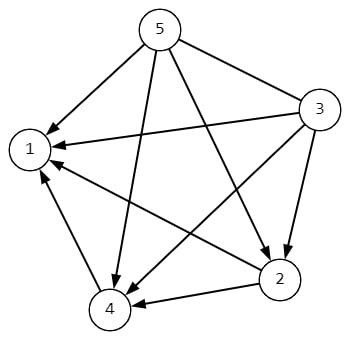 The graph has two strong vertices with numbers $ 3 $ and $ 5 $ . Note that there is a bidirectional edge between vertices $ 3 $ and $ 5 $ .In the third sample, the vertices are connected by a single directed edge from vertex $ 2 $ to vertex $ 1 $ , so the only strong vertex is $ 2 $ .
In the fourth sample, all vertices are connected to each other by bidirectional edges, so there is a path from every vertex to any other vertex.