CF1902D Robot Queries
Description
There is an infinite $ 2 $ -dimensional grid. Initially, a robot stands in the point $ (0, 0) $ . The robot can execute four commands:
- U — move from point $ (x, y) $ to $ (x, y + 1) $ ;
- D — move from point $ (x, y) $ to $ (x, y - 1) $ ;
- L — move from point $ (x, y) $ to $ (x - 1, y) $ ;
- R — move from point $ (x, y) $ to $ (x + 1, y) $ .
You are given a sequence of commands $ s $ of length $ n $ . Your task is to answer $ q $ independent queries: given four integers $ x $ , $ y $ , $ l $ and $ r $ ; determine whether the robot visits the point $ (x, y) $ , while executing a sequence $ s $ , but the substring from $ l $ to $ r $ is reversed (i. e. the robot performs commands in order $ s_1 s_2 s_3 \dots s_{l-1} s_r s_{r-1} s_{r-2} \dots s_l s_{r+1} s_{r+2} \dots s_n $ ).
Input Format
The first line contains two integers $ n $ and $ q $ ( $ 1 \le n, q \le 2 \cdot 10^5 $ ) — the length of the command sequence and the number of queries, respectively.
The second line contains a string $ s $ of length $ n $ , consisting of characters U, D, L and/or R.
Then $ q $ lines follow, the $ i $ -th of them contains four integers $ x_i $ , $ y_i $ , $ l_i $ and $ r_i $ ( $ -n \le x_i, y_i \le n $ ; $ 1 \le l \le r \le n $ ) describing the $ i $ -th query.
Output Format
For each query, print YES if the robot visits the point $ (x, y) $ , while executing a sequence $ s $ , but the substring from $ l $ to $ r $ is reversed; otherwise print NO.
Explanation/Hint
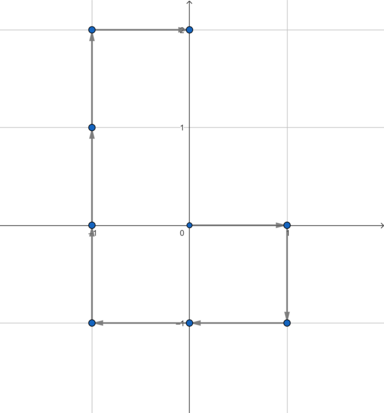
In the first query of the first sample, the path of the robot looks as follows:
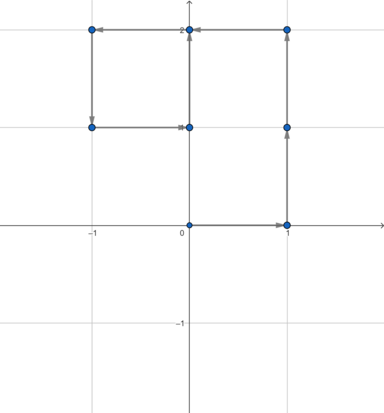In the second query of the first sample, the path of the robot looks as follows:
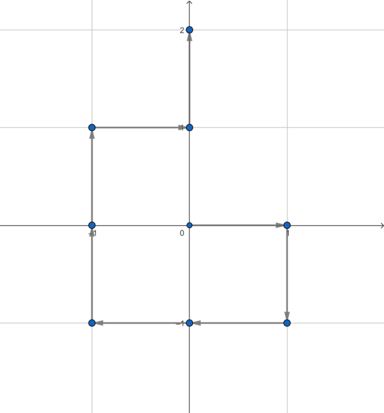In the third query of the first sample, the path of the robot looks as follows: