CF1926B Vlad and Shapes
Description
Vladislav has a binary square grid of $ n \times n $ cells. A triangle or a square is drawn on the grid with symbols $ \texttt{1} $ . As he is too busy being cool, he asks you to tell him which shape is drawn on the grid.
- A triangle is a shape consisting of $ k $ ( $ k>1 $ ) consecutive rows, where the $ i $ -th row has $ 2 \cdot i-1 $ consecutive characters $ \texttt{1} $ , and the central 1s are located in one column. An upside down triangle is also considered a valid triangle (but not rotated by 90 degrees).
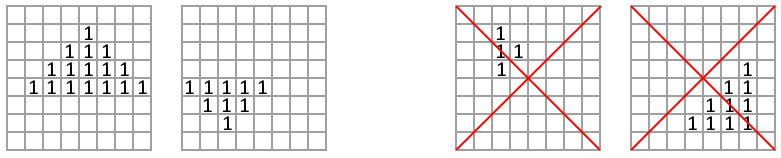 Two left pictures contain examples of triangles: $ k=4 $ , $ k=3 $ . The two right pictures don't contain triangles.- A square is a shape consisting of $ k $ ( $ k>1 $ ) consecutive rows, where the $ i $ -th row has $ k $ consecutive characters $ \texttt{1} $ , which are positioned at an equal distance from the left edge of the grid.
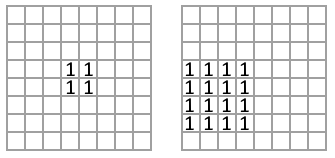 Examples of two squares: $ k=2 $ , $ k=4 $ .For the given grid, determine the type of shape that is drawn on it.
Input Format
The first line contains a single integer $ t $ ( $ 1 \leq t \leq 100 $ ) — the number of test cases.
The first line of each test case contains a single integer $ n $ ( $ 2 \leq n \leq 10 $ ) — the size of the grid.
The next $ n $ lines each contain $ n $ characters $ \texttt{0} $ or $ \texttt{1} $ .
The grid contains exactly one triangle or exactly one square that contains all the $ \texttt{1} $ s in the grid. It is guaranteed that the size of the triangle or square is greater than $ 1 $ (i.e., the shape cannot consist of exactly one 1).
Output Format
For each test case, output "SQUARE" if all the $ \texttt{1} $ s in the grid form a square, and "TRIANGLE" otherwise (without quotes).