CF1928F Digital Patterns
Description
Anya is engaged in needlework. Today she decided to knit a scarf from semi-transparent threads. Each thread is characterized by a single integer — the transparency coefficient.
The scarf is made according to the following scheme: horizontal threads with transparency coefficients $ a_1, a_2, \ldots, a_n $ and vertical threads with transparency coefficients $ b_1, b_2, \ldots, b_m $ are selected. Then they are interwoven as shown in the picture below, forming a piece of fabric of size $ n \times m $ , consisting of exactly $ nm $ nodes:
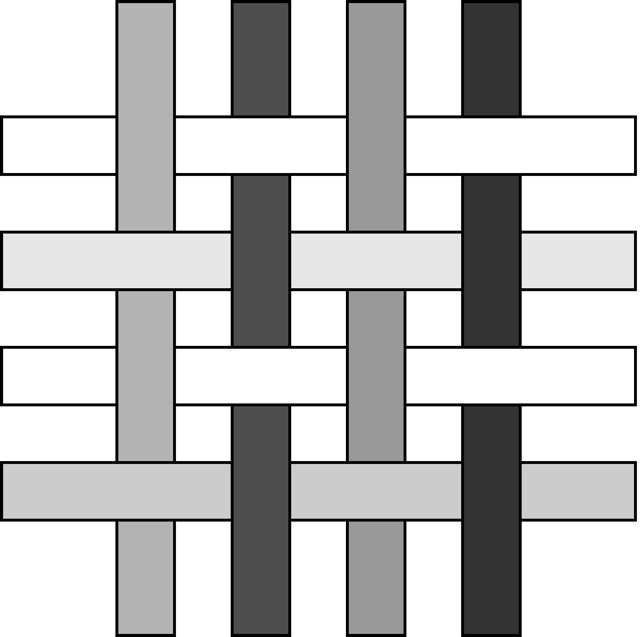 Example of a piece of fabric for $ n = m = 4 $ .After the interweaving tightens and there are no gaps between the threads, each node formed by a horizontal thread with number $ i $ and a vertical thread with number $ j $ will turn into a cell, which we will denote as $ (i, j) $ . Cell $ (i, j) $ will have a transparency coefficient of $ a_i + b_j $ .
The interestingness of the resulting scarf will be the number of its sub-squares $ ^{\dagger} $ in which there are no pairs of neighboring $ ^{\dagger \dagger} $ cells with the same transparency coefficients.
Anya has not yet decided which threads to use for the scarf, so you will also be given $ q $ queries to increase/decrease the coefficients for the threads on some ranges. After each query of which you need to output the interestingness of the resulting scarf.
$ ^{\dagger} $ A sub-square of a piece of fabric is defined as the set of all its cells $ (i, j) $ , such that $ x_0 \le i \le x_0 + d $ and $ y_0 \le j \le y_0 + d $ for some integers $ x_0 $ , $ y_0 $ , and $ d $ ( $ 1 \le x_0 \le n - d $ , $ 1 \le y_0 \le m - d $ , $ d \ge 0 $ ).
$ ^{\dagger \dagger} $ . Cells $ (i_1, j_1) $ and $ (i_2, j_2) $ are neighboring if and only if $ |i_1 - i_2| + |j_1 - j_2| = 1 $ .
Input Format
The first line contains three integers $ n $ , $ m $ , and $ q $ ( $ 1 \le n, m \le 3 \cdot 10^5 $ , $ 0 \le q \le 3 \cdot 10^5 $ ) — the number of horizontal threads, the number of vertical threads, and the number of change requests.
The second line contains $ n $ integers $ a_1, a_2, \ldots, a_n $ ( $ -10^9 \le a_i \le 10^9 $ ) — the transparency coefficients for the horizontal threads, with the threads numbered from top to bottom.
The third line contains $ m $ integers $ b_1, b_2, \ldots, b_m $ ( $ -10^9 \le b_i \le 10^9 $ ) — the transparency coefficients for the vertical threads, with the threads numbered from left to right.
The next $ q $ lines specify the change requests. Each request is described by a quadruple of integers $ t $ , $ l $ , $ r $ , and $ x $ ( $ 1 \le t \le 2 $ , $ l \le r $ , $ -10^9 \le x \le 10^9 $ ). Depending on the parameter $ t $ in the request, the following actions are required:
- $ t=1 $ . The transparency coefficients for the horizontal threads in the range $ [l, r] $ are increased by $ x $ (in other words, for all integers $ l \le i \le r $ , the value of $ a_i $ is increased by $ x $ );
- $ t=2 $ . The transparency coefficients for the vertical threads in the range $ [l, r] $ are increased by $ x $ (in other words, for all integers $ l \le i \le r $ , the value of $ b_i $ is increased by $ x $ ).
Output Format
Output $ (q+1) $ lines. In the $ (i + 1) $ -th line ( $ 0 \le i \le q $ ), output a single integer — the interestingness of the scarf after applying the first $ i $ requests.
Explanation/Hint
In the first example, the transparency coefficients of the cells in the resulting plate are as follows:
2334233434454556Then there are the following sub-squares that do not contain two neighboring cells with the same transparency coefficient:
- Each of the $ 16 $ cells separately;
- A sub-square with the upper left corner at cell $ (3, 1) $ and the lower right corner at cell $ (4, 2) $ ;
- A sub-square with the upper left corner at cell $ (2, 3) $ and the lower right corner at cell $ (3, 4) $ ;
- A sub-square with the upper left corner at cell $ (2, 1) $ and the lower right corner at cell $ (3, 2) $ ;
- A sub-square with the upper left corner at cell $ (3, 3) $ and the lower right corner at cell $ (4, 4) $ .
In the second example, after the first query, the transparency coefficients of the horizontal threads are $ [1, 2, 2] $ . After the second query, the transparency coefficients of the vertical threads are $ [2, -4, 2] $ .