CF1941E Rudolf and k Bridges
Description
Bernard loves visiting Rudolf, but he is always running late. The problem is that Bernard has to cross the river on a ferry. Rudolf decided to help his friend solve this problem.
The river is a grid of $ n $ rows and $ m $ columns. The intersection of the $ i $ -th row and the $ j $ -th column contains the number $ a_{i,j} $ — the depth in the corresponding cell. All cells in the first and last columns correspond to the river banks, so the depth for them is $ 0 $ .
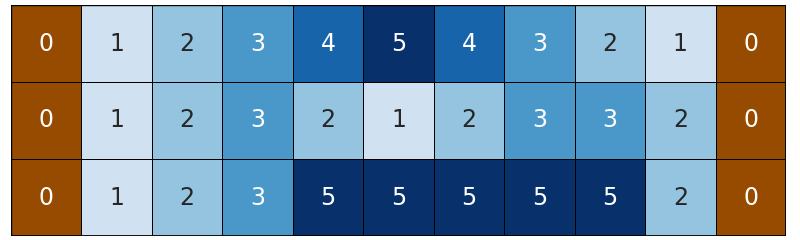 The river may look like this.Rudolf can choose the row $ (i,1), (i,2), \ldots, (i,m) $ and build a bridge over it. In each cell of the row, he can install a support for the bridge. The cost of installing a support in the cell $ (i,j) $ is $ a_{i,j}+1 $ . Supports must be installed so that the following conditions are met:
1. A support must be installed in cell $ (i,1) $ ;
2. A support must be installed in cell $ (i,m) $ ;
3. The distance between any pair of adjacent supports must be no more than $ d $ . The distance between supports $ (i, j_1) $ and $ (i, j_2) $ is $ |j_1 - j_2| - 1 $ .
Building just one bridge is boring. Therefore, Rudolf decided to build $ k $ bridges on consecutive rows of the river, that is, to choose some $ i $ ( $ 1 \le i \le n - k + 1 $ ) and independently build a bridge on each of the rows $ i, i + 1, \ldots, i + k - 1 $ . Help Rudolf minimize the total cost of installing supports.
Input Format
The first line contains a single integer $ t $ $ (1 \le t \le 10^3) $ — the number of test cases. The descriptions of the test cases follow.
The first line of each test case contains four integers $ n $ , $ m $ , $ k $ , and $ d $ ( $ 1 \le k \le n \le 100 $ , $ 3 \le m \le 2 \cdot 10^5 $ , $ 1 \le d \le m $ ) — the number of rows and columns of the field, the number of bridges, and the maximum distance between supports.
Then follow $ n $ lines, $ i $ -th line contains $ m $ positive integers $ a_{i, j} $ ( $ 0 \le a_{i, j} \le 10^6 $ , $ a_{i, 1} = a_{i, m} = 0 $ ) — the depths of the river cells.
It is guaranteed that the sum of $ n \cdot m $ for all sets of input data does not exceed $ 2 \cdot 10^5 $ .
Output Format
For each test case, output a single number — the minimum total cost of supports installation.
Explanation/Hint
In the first test case, it is most profitable to build a bridge on the second row.
 It is not a top view, but side view: gray cells — bridge itself, white cells are empty, black cells — supports, blue cells — water, brown cells — river bottom.In the second test case, it is most profitable to build bridges on the second and third rows. The supports will be placed in cells $ (2, 3) $ , $ (3, 2) $ , and on the river banks.
In the third test case the supports can be placed along the river banks.