CF1942D Learning to Paint
Description
[Pristine Beat - Touhou](https://soundcloud.com/jackaltroy/sets/primordial-beat-pristine-beat)
⠀
Elsie is learning how to paint. She has a canvas of $ n $ cells numbered from $ 1 $ to $ n $ and can paint any (potentially empty) subset of cells.
Elsie has a 2D array $ a $ which she will use to evaluate paintings. Let the maximal contiguous intervals of painted cells in a painting be $ [l_1,r_1],[l_2,r_2],\ldots,[l_x,r_x] $ . The beauty of the painting is the sum of $ a_{l_i,r_i} $ over all $ 1 \le i \le x $ . In the image above, the maximal contiguous intervals of painted cells are $ [2,4],[6,6],[8,9] $ and the beauty of the painting is $ a_{2,4}+a_{6,6}+a_{8,9} $ .
There are $ 2^n $ ways to paint the strip. Help Elsie find the $ k $ largest possible values of the beauty of a painting she can obtain, among all these ways. Note that these $ k $ values do not necessarily have to be distinct. It is guaranteed that there are at least $ k $ different ways to paint the canvas.
Input Format
The first line contains a single integer $ t $ ( $ 1 \leq t \leq 10^3 $ ) — the number of test cases.
The first line of each test case contains $ 2 $ integers $ n $ and $ k $ ( $ 1 \leq n \leq 10^3 $ , $ 1 \leq k \leq \min(2^n, 5 \cdot 10^3) $ ) — the number of cells and the number of largest values of the beauty of a painting you must find.
The next $ n $ lines of each test case describe $ a $ where the $ i $ -th of which contains $ n-i+1 $ integers $ a_{i,i},a_{i,i+1},\ldots,a_{i,n} $ ( $ -10^6 \leq a_{i,j} \leq 10^6 $ ).
It is guaranteed the sum of $ n $ over all test cases does not exceed $ 10^3 $ and the sum of $ k $ over all test cases does not exceed $ 5 \cdot 10^3 $ .
Output Format
For each test case, output $ k $ integers in one line: the $ i $ -th of them must represent the $ i $ -th largest value of the beauty of a painting Elsie can obtain.
Explanation/Hint
In the first test case, Elsie can either paint the only cell or not paint it. If she paints the only cell, the beauty of the painting is $ -5 $ . If she chooses not to paint it, the beauty of the painting is $ 0 $ . Thus, the largest beauty she can obtain is $ 0 $ and the second largest beauty she can obtain is $ -5 $ .
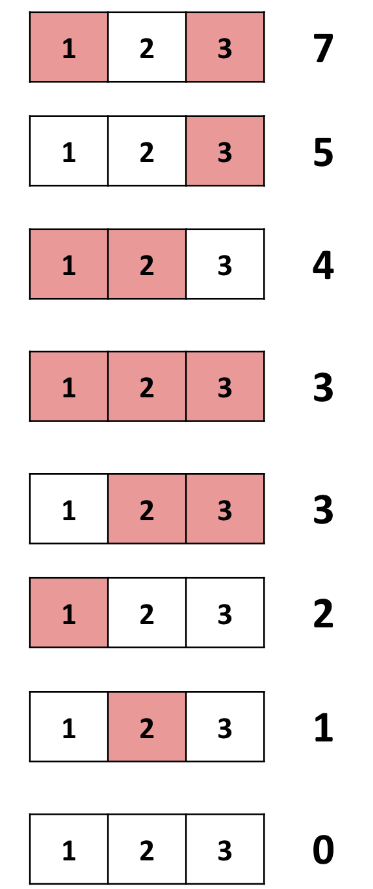
Below is an illustration of the third test case.