CF1946C Tree Cutting
Description
You are given a tree with $ n $ vertices.
Your task is to find the maximum number $ x $ such that it is possible to remove exactly $ k $ edges from this tree in such a way that the size of each remaining connected component $ ^{\dagger} $ is at least $ x $ .
$ ^{\dagger} $ Two vertices $ v $ and $ u $ are in the same connected component if there exists a sequence of numbers $ t_1, t_2, \ldots, t_k $ of arbitrary length $ k $ , such that $ t_1 = v $ , $ t_k = u $ , and for each $ i $ from $ 1 $ to $ k - 1 $ , vertices $ t_i $ and $ t_{i+1} $ are connected by an edge.
Input Format
Each test consists of several sets of input data. The first line contains a single integer $ t $ ( $ 1 \le t \le 10^4 $ ) — the number of sets of input data. This is followed by a description of the sets of input data.
The first line of each set of input data contains two integers $ n $ and $ k $ ( $ 1 \le k < n \le 10^5 $ ) — the number of vertices in the tree and the number of edges to be removed.
Each of the next $ n - 1 $ lines of each set of input data contains two integers $ v $ and $ u $ ( $ 1 \le v, u \le n $ ) — the next edge of the tree.
It is guaranteed that the sum of the values of $ n $ for all sets of input data does not exceed $ 10^5 $ .
Output Format
For each set of input data, output a single line containing the maximum number $ x $ such that it is possible to remove exactly $ k $ edges from the tree in such a way that the size of each remaining connected component is at least $ x $ .
Explanation/Hint
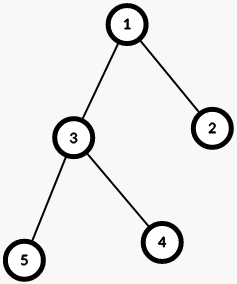
The tree in the first set of input data:
After removing the edge $ 1 $ — $ 3 $ , the tree will look as follows:
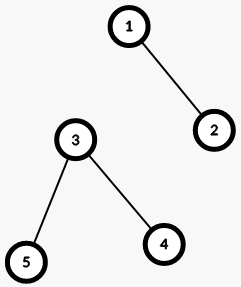The tree has split into two connected components. The first component consists of two vertices: $ 1 $ and $ 2 $ . The second connected component consists of three vertices: $ 3, 4 $ and $ 5 $ . In both connected components, there are at least two vertices. It can be shown that the answer $ 3 $ is not achievable, so the answer is $ 2 $ .