CF1971C Clock and Strings
Description
There is a clock labeled with the numbers $ 1 $ through $ 12 $ in clockwise order, as shown below.
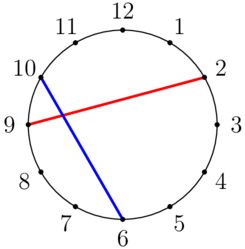In this example, $ (a,b,c,d)=(2,9,10,6) $ , and the strings intersect.
Alice and Bob have four distinct integers $ a $ , $ b $ , $ c $ , $ d $ not more than $ 12 $ . Alice ties a red string connecting $ a $ and $ b $ , and Bob ties a blue string connecting $ c $ and $ d $ . Do the strings intersect? (The strings are straight line segments.)
Input Format
The first line contains a single integer $ t $ ( $ 1 \leq t \leq 5940 $ ) — the number of test cases.
The only line of each test case contains four distinct integers $ a $ , $ b $ , $ c $ , $ d $ ( $ 1 \leq a, b, c, d \leq 12 $ ).
Output Format
For each test case, output "YES" (without quotes) if the strings intersect, and "NO" (without quotes) otherwise.
You can output "YES" and "NO" in any case (for example, strings "yEs", "yes", and "Yes" will be recognized as a positive response).
Explanation/Hint
The first test case is pictured in the statement.
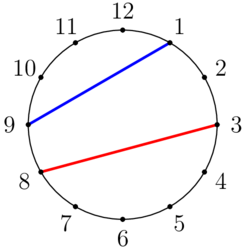
In the second test case, the strings do not intersect, as shown below.