CF2002C Black Circles
Description
There are $ n $ circles on a two-dimensional plane. The $ i $ -th circle is centered at $ (x_i,y_i) $ . Initially, all circles have a radius of $ 0 $ .
The circles' radii increase at a rate of $ 1 $ unit per second.
You are currently at $ (x_s,y_s) $ ; your goal is to reach $ (x_t,y_t) $ without touching the circumference of any circle (including the moment you reach $ (x_t,y_t) $ ). You can move in any direction you want. However, your speed is limited to $ 1 $ unit per second.
Please determine whether this is possible.
Input Format
Each test contains multiple test cases. The first line contains the number of test cases $ t $ ( $ 1\le t\le10^4 $ ). The description of the test cases follows.
The first line of each test case contains a single integer $ n $ ( $ 1\le n\le10^5 $ ) — the number of circles.
The next $ n $ lines each contain two integers $ x_i $ , $ y_i $ ( $ 1\le x_i,y_i\le10^9 $ ) — the center of each circle.
The final line contains four integers $ x_s $ , $ y_s $ , $ x_t $ , $ y_t $ ( $ 1\le x_s,y_s,x_t,y_t\le10^9 $ ) — the coordinates of the starting point and the goal, respectively.
It is guaranteed that these $ n+2 $ points are distinct.
It is guaranteed that the sum of $ n $ over all testcases does not exceed $ 10^5 $ .
Output Format
For each test case, output $ \texttt{YES} $ if it is possible to reach the goal without touching the circle boundaries, and output $ \texttt{NO} $ otherwise.
You can output $ \texttt{Yes} $ and $ \texttt{No} $ in any case (for example, strings $ \texttt{yEs} $ , $ \texttt{yes} $ , $ \texttt{Yes} $ , and $ \texttt{YES} $ will be recognized as a positive response).
Explanation/Hint
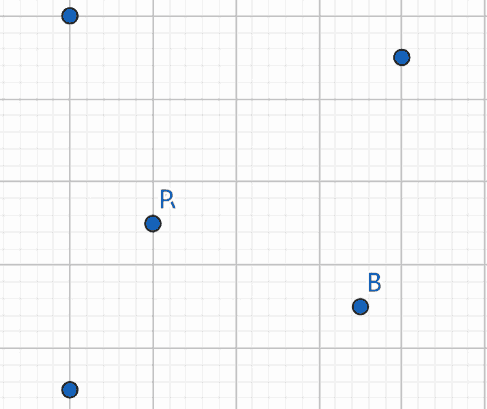
In the first test case, a feasible way of movement is as follows.