CF2108F Fallen Towers
Description
Pizano built an array $ a $ of $ n $ towers, each consisting of $ a_i \ge 0 $ blocks.
Pizano can knock down a tower so that the next $ a_i $ towers grow by $ 1 $ . In other words, he can take the element $ a_i $ , increase the next $ a_i $ elements by one, and then set $ a_i $ to $ 0 $ . The blocks that fall outside the array of towers disappear. If Pizano knocks down a tower with $ 0 $ blocks, nothing happens.
Pizano wants to knock down all $ n $ towers in any order, each exactly once. That is, for each $ i $ from $ 1 $ to $ n $ , he will knock down the tower at position $ i $ exactly once.
Moreover, the resulting array of tower heights must be non-decreasing. This means that after he knocks down all $ n $ towers, for any $ i < j $ , the tower at position $ i $ must not be taller than the tower at position $ j $ .
You are required to output the maximum $ \text{MEX} $ of the resulting array of tower heights.
The $ \text{MEX} $ of an array is the smallest non-negative integer that is not present in the array.
Input Format
Each test contains multiple test cases. The first line contains the number of test cases $ t $ ( $ 1 \le t \le 10^4 $ ). The description of the test cases follows.
The first line of each test case contains an integer $ n $ ( $ 1 \leq n \leq 10^5 $ ) — the number of towers.
The second line of each test case contains $ n $ integers — the initial heights of the towers $ a_1, \ldots, a_n $ ( $ 0 \leq a_i \leq 10^9 $ ).
It is guaranteed that the sum of $ n $ over all test cases does not exceed $ 10^5 $ .
Output Format
For each test case, output a single integer — the maximum $ \text{MEX} $ of the final array.
Explanation/Hint
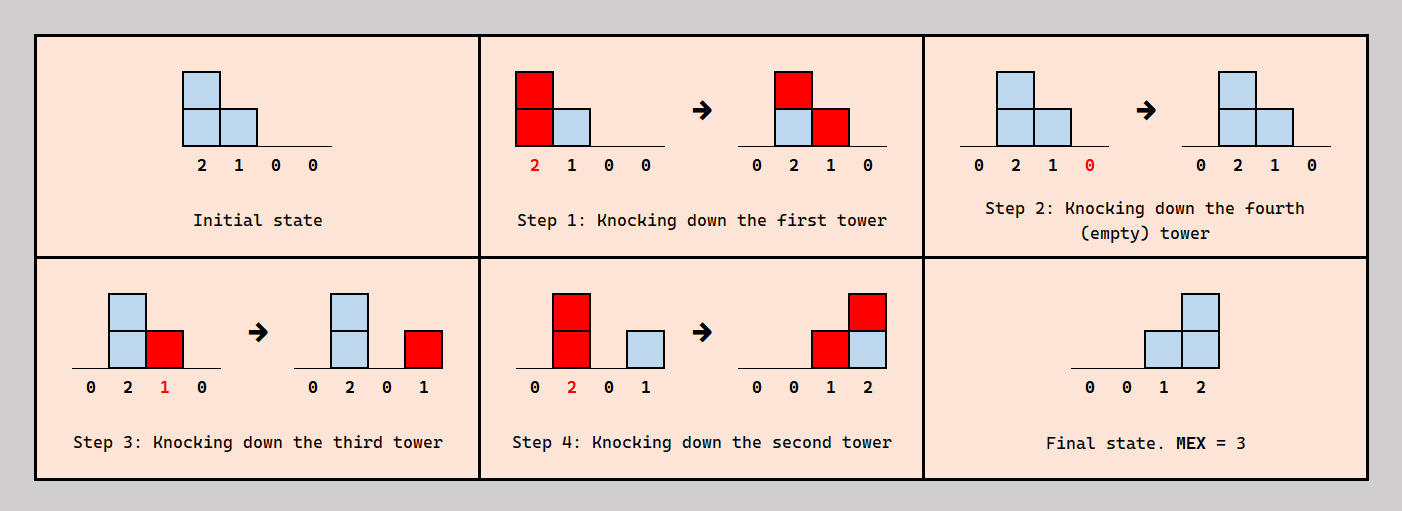
Explanation for the first test case.
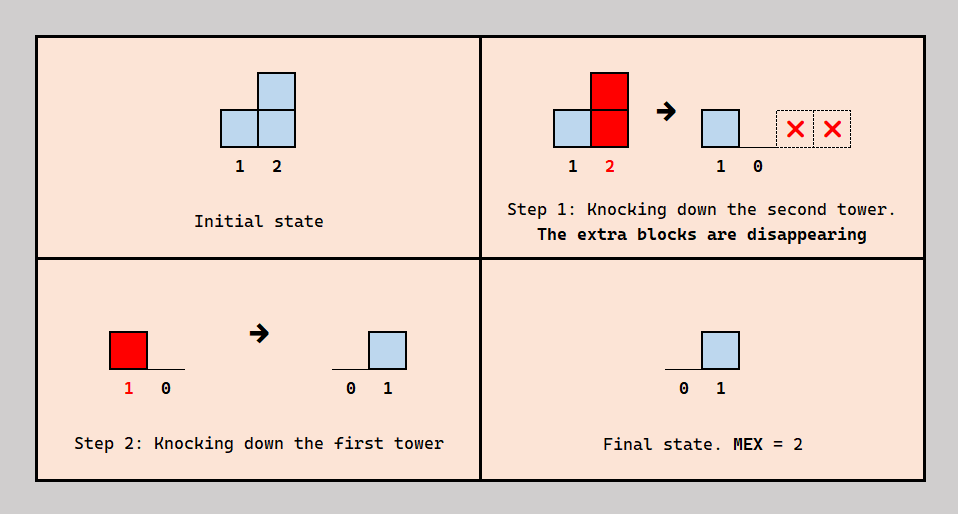Explanation for the second test case. Note that all towers were knocked down exactly once, and the final array of heights is non-decreasing.