CF2112D Reachability and Tree
Description
Let $ u $ and $ v $ be two distinct vertices in a directed graph. Let's call the ordered pair $ (u, v) $ good if there exists a path from vertex $ u $ to vertex $ v $ along the edges of the graph.
You are given an undirected tree with $ n $ vertices and $ n - 1 $ edges. Determine whether it is possible to assign a direction to each edge of this tree so that the number of good pairs in it is exactly $ n $ . If it is possible, print any way to direct the edges resulting in exactly $ n $ good pairs.
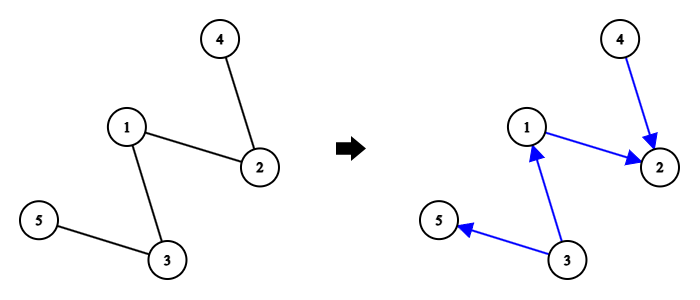 One possible directed version of the tree for the first test case.
Input Format
The first line contains one integer $ t $ ( $ 1 \le t \le 10^4 $ ) — the number of test cases.
The first line of each test case contains one integer $ n $ ( $ 2 \le n \le 2 \cdot 10^5 $ ) — the number of vertices in the tree.
The next $ n - 1 $ lines describe the edges. The $ i $ -th line contains two integers $ u_i $ and $ v_i $ ( $ 1 \le u_i, v_i \le n $ ; $ u_i \neq v_i $ ) — the vertices connected by the $ i $ -th edge.
It is guaranteed that the edges in each test case form an undirected tree and that the sum of $ n $ over all test cases does not exceed $ 2 \cdot 10^5 $ .
Output Format
For each test case, print "NO" (case-insensitive) if it is impossible to direct all edges of the tree and obtain exactly $ n $ good pairs of vertices.
Otherwise, print "YES" (case-insensitive) and then print $ n - 1 $ pairs of integers $ u_i $ and $ v_i $ separated by spaces — the edges directed from $ u_i $ to $ v_i $ .
The edges can be printed in any order. If there are multiple answers, output any.
Explanation/Hint
The tree from the first test case and its possible directed version are shown in the legend above. In this version, there are exactly $ 5 $ good pairs of vertices: $ (3, 5) $ , $ (3, 1) $ , $ (3, 2) $ , $ (1, 2) $ , and $ (4, 2) $ .
One possible directed version of the tree from the second test case is shown below:
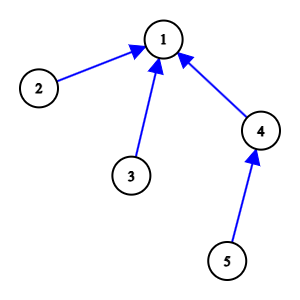In the presented answer, there are exactly $ 5 $ good pairs of vertices: $ (2, 1) $ , $ (3, 1) $ , $ (4, 1) $ , $ (5, 4) $ , and $ (5, 1) $ .
In the third test case, there are only two directed pairs of vertices, but for any direction of the edge, only one pair will be good.