CF2120A Square of Rectangles
Description
Aryan is an ardent lover of squares but a hater of rectangles (Yes, he knows all squares are rectangles). But Harshith likes to mess with Aryan. Harshith gives Aryan three rectangles of sizes $ l_1\times b_1 $ , $ l_2\times b_2 $ , and $ l_3\times b_3 $ such that $ l_3\leq l_2\leq l_1 $ and $ b_3\leq b_2\leq b_1 $ . Aryan, in order to defeat Harshith, decides to arrange these three rectangles to form a square such that no two rectangles overlap and the rectangles are aligned along edges. Rotating rectangles is not allowed. Help Aryan determine if he can defeat Harshith.
Input Format
Each test contains multiple test cases. The first line contains the number of test cases $ t $ ( $ 1 \le t \le 100 $ ). The description of the test cases follows.
Each test case contains a single line with $ 6 $ space-separated integers $ l_1, b_1, l_2, b_2, l_3 $ , and $ b_3 $ ( $ 1 \leq l_3\le l_2\le l_1\le 100 $ , $ 1\le b_3\le b_2\le b_1 \leq 100 $ ) — the dimensions of the three rectangles.
Output Format
For each testcase, print "YES" if the rectangles can be arranged to form a square; otherwise, "NO".
You can output the answer in any case (upper or lower). For example, the strings "yEs", "yes", "Yes", and "YES" will be recognized as positive responses.
Explanation/Hint
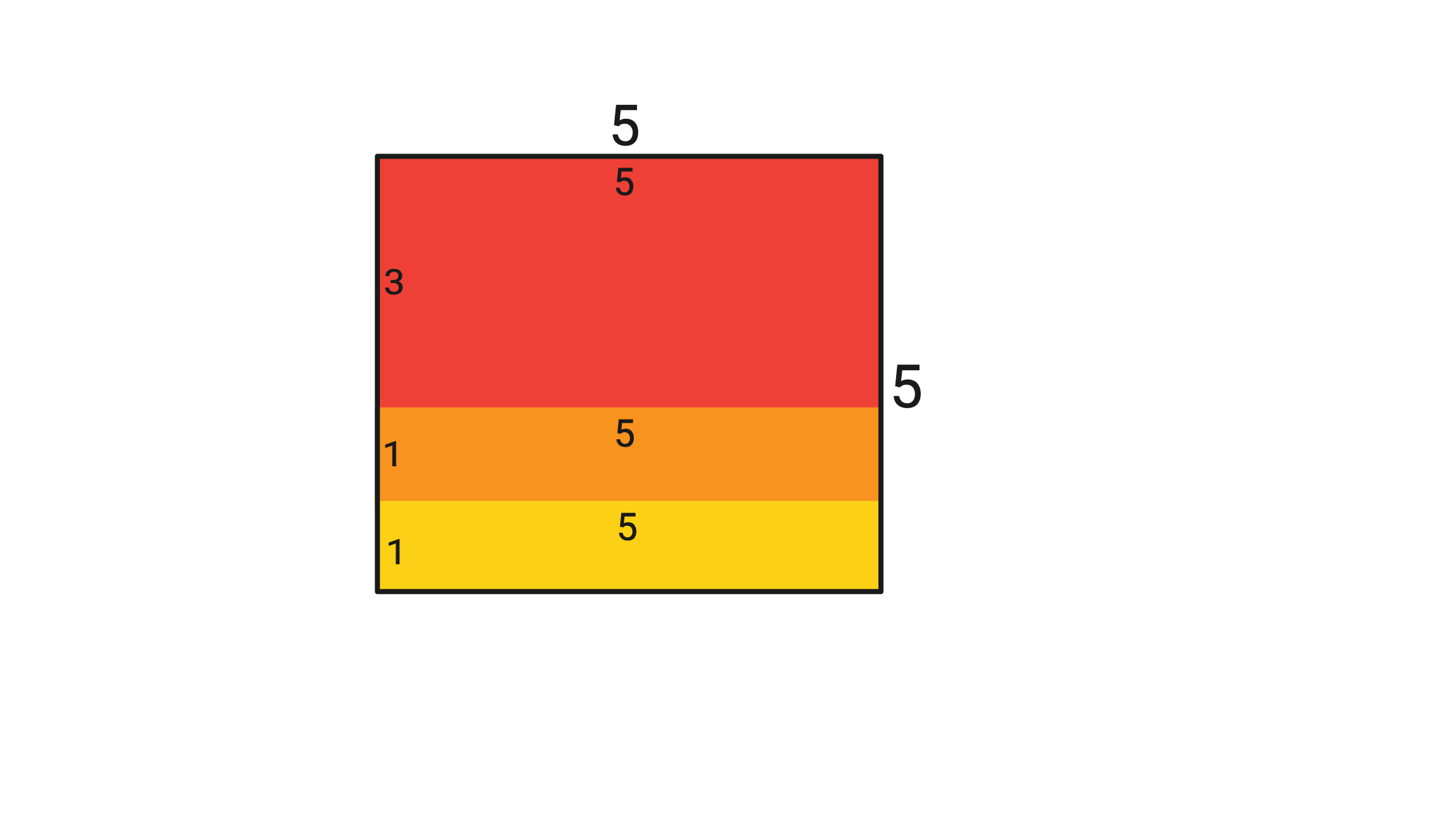
In the second test case, the three rectangles $ 5\times 3 $ , $ 5\times 1 $ , and $ 5\times 1 $ can be arranged as follows to form a square.
In the fourth test case, it can be proven that the rectangles can't be arranged to form a square with the given constraints.