CF2120F Superb Graphs
Description
As we all know, Aryan is a funny guy. He decides to create fun graphs. For a graph $ G $ , he defines fun graph $ G' $ of $ G $ as follows:
- Every vertex $ v' $ of $ G' $ maps to a non-empty independent set $ ^{\text{∗}} $ or clique $ ^{\text{†}} $ in $ G $ .
- The sets of vertices of $ G $ that the vertices of $ G' $ map to are pairwise disjoint and combined cover all the vertices of $ G $ , i.e., the sets of vertices of $ G $ mapped by vertices of $ G' $ form a partition of the vertex set of $ G $ .
- If an edge connects two vertices $ v_1' $ and $ v_2' $ in $ G' $ , then there is an edge between every vertex of $ G $ in the set mapped to $ v_1' $ and every vertex of $ G $ in the set mapped to $ v_2' $ .
- If an edge does not connect two vertices $ v_1' $ and $ v_2' $ in $ G' $ , then there is not an edge between any vertex of $ G $ in the set mapped to $ v_1' $ and any vertex of $ G $ in the set mapped to $ v_2' $ .
As we all know again, Harshith is a superb guy. He decides to use fun graphs to create his own superb graphs. For a graph $ G $ , a fun graph $ G' ' $ is called a superb graph of $ G $ if $ G' ' $ has the minimum number of vertices among all possible fun graphs of $ G $ .
Aryan gives Harshith $ k $ simple undirected graphs $ ^{\text{‡}} $ $ G_1, G_2,\ldots,G_k $ , all on the same vertex set $ V $ . Harshith then wonders if there exist $ k $ other graphs $ H_1, H_2,\ldots,H_k $ , all on some other vertex set $ V' $ such that:
- $ G_i $ is a superb graph of $ H_i $ for all $ i\in \{1,2,\ldots,k\} $ .
- If a vertex $ v\in V $ maps to an independent set of size greater than $ 1 $ in one $ G_i, H_i $ ( $ 1\leq i\leq k $ ) pair, then there exists no pair $ G_j, H_j $ ( $ 1\leq j\leq k, j\neq i $ ) where $ v $ maps to a clique of size greater than $ 1 $ .
Help Harshith solve his wonder.
$ ^{\text{∗}} $ For a graph $ G $ , a subset $ S $ of vertices is called an independent set if no two vertices of $ S $ are connected with an edge.
$ ^{\text{†}} $ For a graph $ G $ , a subset $ S $ of vertices is called a clique if every vertex of $ S $ is connected to every other vertex of $ S $ with an edge.
$ ^{\text{‡}} $ A graph is a simple undirected graph if its edges are undirected and there are no self-loops or multiple edges between the same pair of vertices.
Input Format
Each test contains multiple test cases. The first line contains the number of test cases $ t $ ( $ 1 \le t \le 100 $ ). The description of the test cases follows.
The first line of each test case contains two integers $ n $ and $ k $ ( $ 1\leq n\leq 300, 1\leq k\leq 10 $ ).
Then, there are $ k $ graphs described. The first line of each graph description contains a single integer $ m $ ( $ 0\leq m\leq \frac{n\cdot(n-1)}{2} $ ).
Next $ m $ lines each contain two space-separated integers $ u $ and $ v $ ( $ 1\leq u, v\leq n, u\neq v $ ), denoting that an edge connects vertices $ u $ and $ v $ .
It is guaranteed that the sum of $ m $ over all graphs over all test cases does not exceed $ 2\cdot 10^5 $ , and the sum of $ n $ over all test cases does not exceed $ 300 $ .
Output Format
For each testcase, print "Yes" if there exists $ k $ graphs satisfying the conditions; otherwise, "No".
You can output the answer in any case (upper or lower). For example, the strings "yEs", "yes", "Yes", and "YES" will be recognized as positive responses.
Explanation/Hint
For the first test case, the following are the graphs of $ G_1, H_1 $ and $ G_2, H_2 $ such that $ G_1 $ is superb graph of $ H_1 $ and $ G_2 $ is superb graph of $ H_2 $ .
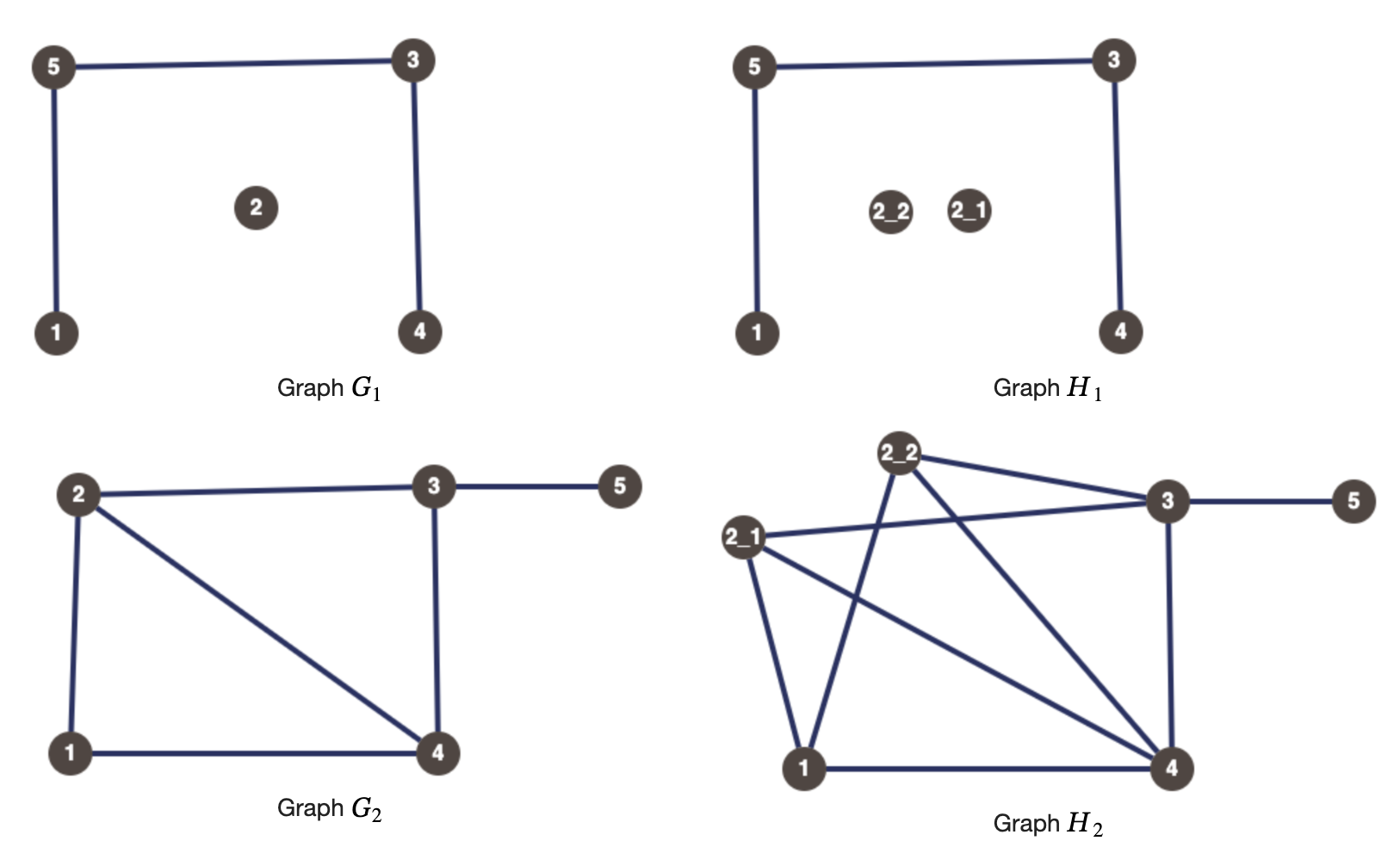In each graph, vertex $ 2 $ of $ G_i $ corresonds to independent set $ \{2\_1, 2\_2\} $ of corresponding $ H_i $ and remaining vertices $ v\in\{1,3,4,5\} $ of $ G_i $ correspond to independent set/clique $ \{v\} $ in corresponding $ H_i $ (a single vertex set can be considered both an independent set and a clique).
In the third test case, it can be proven that the answer is "No".