CF2120G Eulerian Line Graph
Description
Aryan loves graph theory more than anything. Well, no, he likes to flex his research paper on line graphs to everyone more. To start a conversation with you, he decides to give you a problem on line graphs. In the mathematical discipline of graph theory, the line graph of a simple undirected graph $ G $ is another simple undirected graph $ L(G) $ that represents the adjacency between every two edges in $ G $ .
Precisely speaking, for an undirected graph $ G $ without self-loops or multiple edges, its line graph $ L(G) $ is a graph such that
- Each vertex of $ L(G) $ represents an edge of $ G $ .
- Two vertices of $ L(G) $ are adjacent if and only if their corresponding edges share a common endpoint in $ G $ .
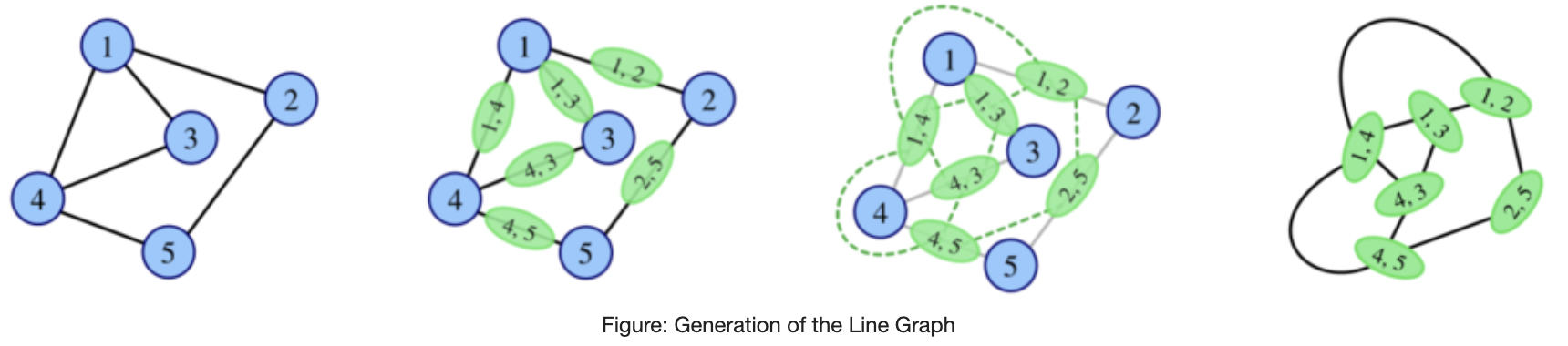Also, $ L^0(G)=G $ and $ L^k(G)=L(L^{k-1}(G)) $ for $ k\geq 1 $ .
An Euler trail is a sequence of edges that visits every edge of the graph exactly once. This trail can be either a path (starting and ending at different vertices) or a cycle (starting and ending at the same vertex). Vertices may be revisited during the trail, but each edge must be used exactly once.
Aryan gives you a simple connected graph $ G $ with $ n $ vertices and $ m $ edges and an integer $ k $ , and it is guaranteed that $ G $ has an Euler trail and it is not a path graph $ ^{\text{∗}} $ . He asks you to determine if $ L^k(G) $ has an Euler trail.
$ ^{\text{∗}} $ A path graph is a tree where every vertex is connected to atmost two other vertices.
Input Format
Each test contains multiple test cases. The first line contains the number of test cases $ t $ ( $ 1 \le t \le 10^4 $ ). The description of the test cases follows.
The first line of each test case contains three space-separated integers $ n $ , $ m $ , and $ k $ ( $ 5 \le n \le 2 \cdot 10^5 $ , $ n-1 \le m \le \min(\frac{n\cdot(n-1)}{2} ,2 \cdot 10^5) $ , $ 1 \le k \le 2 \cdot 10^5 $ ).
The next $ m $ lines of each test case contain two space-separated integers $ u $ and $ v $ ( $ 1 \le u,v \le n $ , $ u \neq v $ ), denoting that an edge connects vertices $ u $ and $ v $ .
It is guaranteed that the sum of $ n $ and $ m $ over all test cases does not exceed $ 2\cdot 10^5 $ .
Output Format
For each testcase, print "YES" if $ L^k(G) $ has an Euler trail; otherwise, "NO".
You can output the answer in any case (upper or lower). For example, the strings "yEs", "yes", "Yes", and "YES" will be recognized as positive responses.
Explanation/Hint
For the first test case, $ L^2(G) $ is isomorphic to $ G $ itself. So, since $ G $ has an Euler trail, $ L^2(G) $ also has an Euler trail.
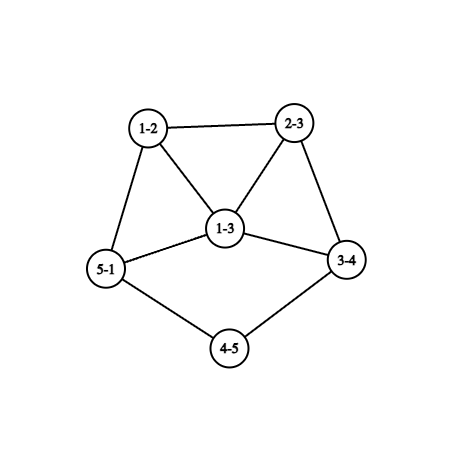
For the second test case, $ L(G) $ looks as follows(Vertex $ i-j $ of $ L(G) $ in figure corresponds to edge between vertices $ i $ and $ j $ of $ G $ ). It can be proven that this doesn't have an Euler trail.